
Hyaluronic Acid · Complete Guide
Hyaluronic acid supplements: a complete guide
You moisturize every morning, and by lunch your skin feels tight again. Hyaluronic acid is the molecule your body uses to hold water where your skin needs it, and this guide covers what a daily capsule actually does, how much you need, and how it works alongside the serum you’re already using.
What hyaluronic acid does for your skin
Hyaluronic acid is your body’s own moisture magnet. It’s a sugar-based molecule that sits in the spaces between your cells and holds water in place, which keeps skin looking full and feeling comfortable rather than tight.
Most of it lives in your skin. Human skin carries roughly 400 to 500 micrograms of hyaluronic acid per gram of tissue, concentrated in the dermis, and a 2012 review in Dermato-Endocrinology puts the skin’s share at about half of all the hyaluronic acid in your body.[1,2] A 70-kilogram adult carries around 15 grams of it and replaces roughly 5 grams every single day.[3]
Very little of it goes a long way. A single hyaluronic acid molecule unfurls into a domain hundreds of nanometers across, and a 2015 analysis in F1000Research measured a six-million-dalton chain spanning about 600 nanometers.[4] That whole space fills with water the molecule holds in place, which is why a small amount does so much and why this ingredient turns up in everything from serums to injectables.
What changes in your skin over time
Your skin doesn’t run out of hyaluronic acid as you age. It locks more of it away, which is a friendlier truth than the version you’ll read elsewhere — and a better-supported one.
A 1994 study in the Journal of Investigative Dermatology measured hyaluronan in human skin from infancy through old age. Researchers found no meaningful drop in either the total amount or the size of the molecules. What shifted was availability. The share bound tightly to surrounding tissue climbed from 7% in the youngest samples to 23% in the oldest, so there’s just as much hyaluronic acid present but far less of it free to do its job.[5] The 2012 Dermato-Endocrinology review describes the clearest change in older skin as hyaluronic acid disappearing from the epidermis, the outer layer, while it holds steady in the dermis underneath.[1]
Put those findings together and you get a familiar feeling. The outer layer of your skin loses the molecule that holds onto water, and that’s exactly where dryness, tightness, and fine lines show up first. It’s a real change, and it’s redistribution rather than depletion. Knowing which one it is tells you what a supplement is realistically doing.
What a hyaluronic acid supplement supports
Four benefits have solid human research behind them. Here’s what each one looks like in practice.
Skin hydration
This is the strongest of the four. A 2025 analysis pooling seven randomized controlled trials found that daily hyaluronic acid measurably improved skin hydration compared with placebo.[6]
Skin elasticity
Skin that bounces back. The same 2025 analysis found a clear improvement in elasticity, echoed in a 2025 trial of 150 adults taking 120 mg daily for 12 weeks. [6][7]
Softer-looking fine lines
Especially around the eyes. A 2017 study measured crow’s feet using skin replicas and found a visible difference from week eight.[8]
Joint comfort
A welcome bonus. In a 2025 trial, healthy adults taking 80 mg or 150 mg daily for 12 weeks reported less knee stiffness and easier everyday movement.[9]
Those results have turned up in adults from their twenties into their sixties, at doses from 60 mg to 240 mg a day.[8][10][11] Different skin types produced the same direction of result each time. That consistency is what makes hyaluronic acid one of the ingredients we’re most comfortable standing behind.
What it won’t do
A hyaluronic acid supplement is a daily habit that supports how your skin holds moisture. It isn’t a wrinkle eraser, a filler substitute, or a way around sunscreen, sleep, and drinking enough water.
Its strengths are specific, which is useful when you’re deciding what to buy. Hydration, suppleness, and the look of fine lines are where the research consistently lands.[6,7] If your main concern is something else, like pore size or uneven tone, a different ingredient will serve you better.
Does taking hyaluronic acid as a capsule work?
Yes, though not the way most people picture it. Hyaluronic acid is a large molecule, and it doesn’t travel intact from your stomach to your face.
A 2016 study found that hyaluronic acid passes stomach acid untouched, then gets broken down by the bacteria in your gut into much smaller pieces. Those pieces are absorbed and carried through your bloodstream to tissues, including skin.[12] Your gut does the work of shrinking it to a usable size.
In a 2025 randomized, placebo-controlled trial of 150 healthy adults, twelve weeks of daily hyaluronic acid produced measurable increases in skin hydration, elasticity, epidermal thickness, and dermal density.[7]
Supplement or serum? You want both
Your serum handles the surface and your supplement works underneath. They’re teammates rather than alternatives, and the reason comes down to molecular size.
Topical hyaluronic acid can only travel so far. A 2016 study tracked different molecular sizes through human skin and found that the large molecules never made it past the outermost layer, while even the smallest fragments stopped at the base of the epidermis.[13] A 2023 study designed specifically to push hyaluronic acid deeper found the same ceiling.[14] For scale, the hyaluronic acid your own skin makes is several times larger than anything in a bottle.[2]
None of that makes serums less worthwhile. Surface hydration is real and immediate, and a serum delivers it in minutes in a way no capsule can.[15] The two simply do different jobs, which is why we suggest keeping the routine you have and adding to it. There’s more on this in our guide to oral versus topical hyaluronic acid.
How to choose a hyaluronic acid supplement
Four things separate a formula that works from one that just says hyaluronic acid on the front. This is the checklist we use on our own products.
A real dose you can see on the label
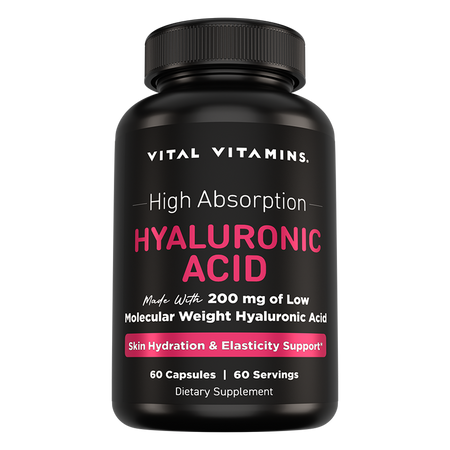
Human trials have used daily doses ranging from 48 mg to 240 mg, with 120 mg for twelve weeks the most repeated combination.[8,16] Our Hyaluronic Acid Capsules deliver 200 mg in a single capsule, which sits at the upper end of that range in one pill a day. What you want to avoid is a label showing a large blend that happens to contain hyaluronic acid somewhere inside it, because that’s a very different product.
Molecular weight, explained honestly
We use low molecular weight hyaluronic acid, which absorbs readily. A 2015 study compared two sizes and both increased skin moisture, with the smaller one lasting longer after people stopped taking it.[17] A 2017 study ran a tiny 2-kilodalton form against a 300-kilodalton form and both beat placebo.[8] Treat molecular weight as a detail worth understanding rather than the deciding factor.
Hyaluronic acid on its own, or with a supporting cast
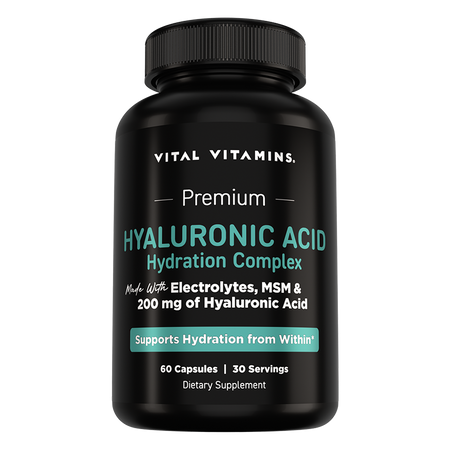
This choice is about your routine rather than about quality. A single-ingredient capsule slots cleanly into a stack you’ve already built. A complex makes sense if you’d rather get everything in one serving. Our Hyaluronic Acid Hydration Complex pairs the same 200 mg with electrolytes, coconut water powder, MSM, silica, L-taurine, L-proline, and vitamin C, which your body needs to build collagen normally.[18]
Third-party testing and a label you can read
You should be able to find the exact milligrams of hyaluronic acid on the supplement facts panel, and the product should be third-party tested. Ours are third-party tested, GMP compliant, non-GMO, and made in the USA. One label note trips people up regularly: “hyaluronic acid (as sodium hyaluronate)” is the same molecule in its more stable salt form. It’s what the research studies used too, and it isn’t a cheaper stand-in.[7]
Who this is for
If your skin runs dry, feels tight after a shower, or looks dull by February, you’re exactly who these studies recruited. The trials showing the fastest results specifically enrolled people with dry skin, and their participants skewed toward adults from their mid-thirties into their mid-sixties.[10,17]
Two situations are worth a quick conversation with your doctor first. Talk to them if you’re pregnant or breastfeeding, or if you’re managing an ongoing health condition. We cover both honestly in our guide to hyaluronic acid side effects and safety.[19]
How to take it, and when you’ll notice
Take one capsule once a day, with food and water, whenever you’ll actually remember it. Consistency beats timing every time.
- Take the hyaluronic acid supplement daily with a meal.
- Keep it alongside whatever you already take for skin, whether that’s collagen, biotin, or a multivitamin. Nothing here competes.
- Leave your topical routine exactly as it is.
- Give it twelve weeks before you decide.
Skin moisture improved by around six weeks in the studies that tracked it, and differences in elasticity and fine lines generally showed up from week eight, and twelve weeks is the standard finish line.[6,8,17] Individual results vary. One encouraging detail from a 2015 study: the improvement in skin moisture was still measurable two weeks after people stopped taking it, so a missed day won’t undo your progress.[17]
It’s also an easy ingredient to live with. A 2019 study funded by the National Institutes of Health gave 140 mg a day to healthy adults and ran a full panel of blood, liver, kidney, inflammatory, and gut measures, finding no meaningful changes and no serious side effects.[20]
What else affects how your skin holds water
A supplement is one lever, and it works best when the others aren’t working against it. None of the following is complicated, and most of it is free.
Hot showers. That tight feeling right after you towel off is real, because very hot water strips the oils that keep moisture in. Use warm water instead, and moisturize while your skin is still slightly damp.
Dry air. Winter heating and summer air conditioning both pull moisture out of your skin all day long. That’s why skin behaving perfectly in June turns tight and flaky in January. A humidifier in the bedroom is the easiest fix most people skip.
Sun exposure. Daily SPF protects the structures in your skin that keep it firm and hydrated. No supplement compensates for skipping it. If you only do one of the two, wear the sunscreen.
Water and protein. Hydration starts with actually drinking enough, and your skin needs protein to rebuild itself. A supplement supports a well-fed body rather than substituting for one.
Sleep. Your skin does most of its repair work overnight. It’s the least glamorous item on this list and probably the most powerful.
Get those roughly right and a hyaluronic acid supplement has something to build on. That’s true of every supplement we make, which is why we give you the whole picture instead of pretending a capsule is the whole answer.
Which of our two formulas fits you
Both formulas deliver the same 200 mg of hyaluronic acid. The difference is what comes with it, and it’s a question of routine rather than quality.
Hyaluronic Acid Capsules are for a routine you’ve already built. One capsule, once a day, one ingredient. If you already take collagen or a multivitamin and want to add hydration support without another complicated label, this is the straightforward choice. It’s vegan, gluten-free, non-GMO, keto-friendly, and soy-free.
Hyaluronic Acid Hydration Complex is for hydration from more than one angle. Two capsules a day carry the same 200 mg of hyaluronic acid plus a supporting cast, each with a job:
- Electrolytes are sodium, potassium, magnesium, and calcium, the minerals that help your body hold onto the water you drink rather than passing it straight through.
- Coconut water powder is a natural source of those same electrolytes.
- MSM is a sulfur compound that supports skin elasticity and joint comfort.
- Silica from bamboo helps skin stay resilient and hold water where it belongs.
- L-proline is one of the amino acids your body uses to build collagen.
- L-taurine supports hydration at the cellular level.
- Vitamin C is required for normal collagen production and is an antioxidant.[18]
If you tend toward dehydration generally, whether from long days on your feet, a hot climate, or a lot of coffee, the Complex covers more ground. If you want hyaluronic acid and nothing else, take the Capsules.
Where it fits with collagen and biotin
Collagen is the scaffolding and hyaluronic acid is the water held in the spaces around it. Collagen is the broader pick, covering skin, joints, hair, and nails together. Hyaluronic acid is the specialist for hydration and suppleness. Biotin sits mostly on the hair and nails side, and vitamin C works underneath all of it, since your body needs it to make collagen in the first place.[18]
One honest note before you buy both. In a 2024 randomized trial, adding 30 mg of hyaluronic acid to collagen and vitamin C didn’t measurably outperform collagen and vitamin C on their own.[21] That’s a quarter of the dose used in trials where hyaluronic acid works by itself, which may well explain the result, but it’s the only head-to-head evidence there is. We won’t tell you the pairing multiplies anything. Take both because you want both benefits. Our guide to collagen and hyaluronic acid together walks through it properly.
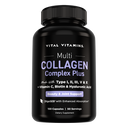
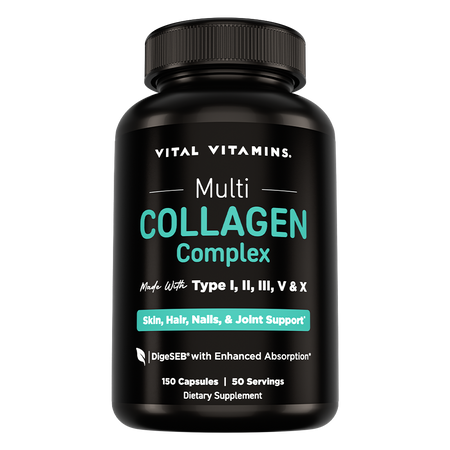
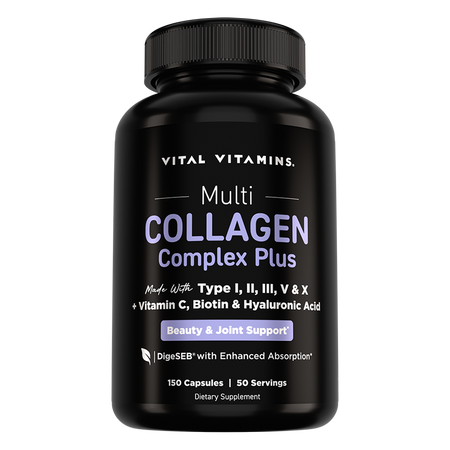
The same caution applies to our own formulas. Multi Collagen Complex Plus includes hyaluronic acid in its 200 mg Glowing Beauty Complex alongside MSM, keratin, astaxanthin, and more. It’s a strong beauty formula and the collagen dose is substantial at 1,600 mg, but the hyaluronic acid inside is one part of that blend rather than a 200 mg serving. If hydration is your goal, take it as its own capsule.
Keep reading
More on hyaluronic acid
Frequently asked questions
For hydration and elasticity, yes. A 2025 analysis pooling seven randomized controlled trials found that daily hyaluronic acid measurably improved skin hydration, elasticity, and the depth of fine lines compared with placebo.[6] It didn’t change overall firmness or pore size, so set your expectations around moisture and suppleness.
Human trials have used 48 mg to 240 mg daily, with 120 mg the most repeated dose.[16] Our capsules give you 200 mg in one daily serving.
Expect around six weeks for how your skin feels and eight to twelve weeks for what you see.[8,17] Individual results vary, so give it a full twelve weeks before judging.
No, keep both. Topical hyaluronic acid works on the surface and stops at the outer layers of skin, while a capsule supports hydration from within.[13] They’re doing different jobs.
Absolutely, and plenty of people do. Just take both because you want both benefits, since a 2024 trial found that adding 30 mg of hyaluronic acid to collagen and vitamin C didn’t outperform collagen and vitamin C alone.[21]
Ours is. It’s fermentation-derived sodium hyaluronate in a vegetable capsule, and it’s vegan, gluten-free, non-GMO, keto-friendly, and soy-free.
It looks that way. In a 2025 trial, healthy adults taking 80 mg or 150 mg daily for 12 weeks reported less knee pain and stiffness and easier everyday movement than those on placebo.[9] That’s one study, so we’d call it a welcome bonus rather than the main reason to take it.
Both deliver 200 mg of hyaluronic acid. The Capsules are just that, in one pill a day. The Hydration Complex adds electrolytes, MSM, silica, and vitamin C across a two-capsule serving for broader hydration support.
The science
Studies
Hyaluronic acid: A key molecule in skin aging
View sourceVitamin C: Fact Sheet for Health Professionals
View sourceThe effects of dietary supplementation with collagen and vitamin C and their combination with hyaluronic acid on skin density, texture and other parameters: A randomised, double-blind, placebo-controlled trial
View sourceView All Studies Show fewer
Oral hyaluronic acid supplement: Efficacy in skin hydration, elasticity, and wrinkle depth reduction
View sourceOral sodium hyaluronate improves skin hydration, barrier function and signs of aging: A randomized, double-blind, placebo-controlled trial in 150 healthy adults
View sourceSafety of Hyaluronan 35 in healthy human subjects: A pilot study
View sourceRole of oral hyaluronic acid for joint health: Insights from rat models and clinical trials
View sourceIngestion of hyaluronans (molecular weights 800 k and 300 k) improves dry skin conditions: A randomized, double blind, controlled study
View sourceAdvantages of hyaluronic acid and its combination with other bioactive ingredients in cosmeceuticals
View sourceOral hyaluronan relieves knee pain: A review
View sourceOral hyaluronan relieves wrinkles: A double-blinded, placebo-controlled study over a 12-week period
View sourceIngested hyaluronan moisturizes dry skin
View sourceOral supplementation with a new hyaluronic acid matrix ingredient improves skin brightness, hydration, smoothness, and roughness: Results from a randomized, double-blinded, placebo-controlled study
View sourceHuman skin penetration of hyaluronic acid of different molecular weights as probed by Raman spectroscopy
View sourceHyaluronic acid in topical applications: The various forms and biological effects of a hero molecule in the cosmetics industry
View sourceBiocompatible topical delivery system of high-molecular-weight hyaluronan into human stratum corneum using magnesium chloride
View sourceAbsorption of orally administered hyaluronan
View sourceViscoelastic properties of hyaluronan in physiological conditions
View sourceReferences
- Papakonstantinou E, Roth M, Karakiulakis G (2012). Hyaluronic acid: A key molecule in skin aging. Dermato-Endocrinology, 4(3), 253–258.
- Cowman MK, Lee H-G, Schwertfeger KL, McCarthy JB, Turley EA (2015). The content and size of hyaluronan in biological fluids and tissues. Frontiers in Immunology, 6, 261.
- Juncan AM, Moișă DG, Santini A, Morgovan C, Rus L-L, Vonica-Țincu AL, Loghin F (2021). Advantages of hyaluronic acid and its combination with other bioactive ingredients in cosmeceuticals. Molecules, 26(15), 4429.
- Cowman MK, Schmidt TA, Raghavan P, Stecco A (2015). Viscoelastic properties of hyaluronan in physiological conditions. F1000Research, 4, 622.
- Meyer LJ, Stern R (1994). Age-dependent changes of hyaluronan in human skin. Journal of Investigative Dermatology, 102(3), 385–389.
- Amin P, Sarabi A, Choe S, Scott S, Suh S, Mesinkovska NA (2025). Oral hyaluronic acid supplement: Efficacy in skin hydration, elasticity, and wrinkle depth reduction. Journal of Drugs in Dermatology, 24(9), 910–919.
- Dolečková I, Kušnierik P, Berka V, Šimek M, Matějková I, Prokopec F, Ovesná P (2025). Oral sodium hyaluronate improves skin hydration, barrier function and signs of aging: A randomized, double-blind, placebo-controlled trial in 150 healthy adults. Scientific Reports, 16(1), 2941.
- Oe M, Sakai S, Yoshida H, Okado N, Kaneda H, Masuda Y, Urushibata O (2017). Oral hyaluronan relieves wrinkles: A double-blinded, placebo-controlled study over a 12-week period. Clinical, Cosmetic and Investigational Dermatology, 10, 267–273.
- Wang B, Wang F, Zhang T, Bai J, Cui S, Shi H (2025). Role of oral hyaluronic acid for joint health: Insights from rat models and clinical trials. Frontiers in Nutrition, 12, 1691328.
- Montero-Vilchez T, Gálvez-Martín P, Sanabria-de la Torre R, Cuenca-Barrales C, Molina-Leyva A, Martinez-Puig D, Velasco-Alvarez J, Arias-Santiago S (2025). Oral supplementation with a new hyaluronic acid matrix ingredient improves skin brightness, hydration, smoothness, and roughness: Results from a randomized, double-blinded, placebo-controlled study. Dermatology and Therapy, 15(8), 2099–2116.
- Kawada C, Yoshida T, Yoshida H, Matsuoka R, Sakamoto W, Odanaka W, Sato T, Yamasaki T, Kanemitsu T, Masuda Y, Urushibata O (2014). Ingested hyaluronan moisturizes dry skin. Nutrition Journal, 13, 70.
- Kimura M, Maeshima T, Kubota T, Kurihara H, Masuda Y, Nomura Y (2016). Absorption of orally administered hyaluronan. Journal of Medicinal Food, 19(12), 1172–1179.
- Essendoubi M, Gobinet C, Reynaud R, Angiboust JF, Manfait M, Piot O (2016). Human skin penetration of hyaluronic acid of different molecular weights as probed by Raman spectroscopy. Skin Research and Technology, 22(1), 55–62.
- Fujii MY, Okishima A, Ichiwata HS, Oka T (2023). Biocompatible topical delivery system of high-molecular-weight hyaluronan into human stratum corneum using magnesium chloride. Scientific Reports, 13, 10782.
- Zanchetta C, Scandolera A, Reynaud R (2025). Hyaluronic acid in topical applications: The various forms and biological effects of a hero molecule in the cosmetics industry. Biomolecules, 15(12), 1656.
- Oe M, Tashiro T, Yoshida H, Nishiyama H, Masuda Y, Maruyama K, Koikeda T, Maruya R, Fukui N (2016). Oral hyaluronan relieves knee pain: A review. Nutrition Journal, 15, 11.
- Kawada C, Yoshida T, Yoshida H, Sakamoto W, Odanaka W, Sato T, Yamasaki T, Kanemitsu T, Masuda Y, Urushibata O (2015). Ingestion of hyaluronans (molecular weights 800 k and 300 k) improves dry skin conditions: A randomized, double blind, controlled study. Journal of Clinical Biochemistry and Nutrition, 56(1), 66–73.
- National Institutes of Health, Office of Dietary Supplements (2025). Vitamin C: Fact sheet for health professionals. NIH Office of Dietary Supplements.
- Procopio S, Migliore A (2015). Caution should be used in long-term treatment with oral compounds of hyaluronic acid in patients with a history of cancer. Clinical Drug Investigation, 35(11), 689–692.
- Bellar A, Kessler SP, Obery DR, Sangwan N, Welch N, Nagy LE, Dasarathy S, de la Motte C (2019). Safety of Hyaluronan 35 in healthy human subjects: A pilot study. Nutrients, 11(5), 1135.
- Žmitek K, Žmitek J, Hristov H, Rogl Butina M, Keršmanc P, Pogačnik T (2024). The effects of dietary supplementation with collagen and vitamin C and their combination with hyaluronic acid on skin density, texture and other parameters: A randomised, double-blind, placebo-controlled trial. Nutrients, 16(12), 1908.
Ready to start?
Hydration that works from the inside out
If you want hyaluronic acid and nothing else, Hyaluronic Acid Capsules give you 200 mg in a single daily capsule, which is the simplest way to add it to a routine you already have. If you’d rather have the full hydration lineup in one serving, Hyaluronic Acid Hydration Complex pairs it with electrolytes, MSM, silica, and vitamin C to support skin and joints together.* Browse the whole skin, hair and nails collection to see how they fit with collagen and biotin.
Live Long. Live Well.
* These statements have not been evaluated by the Food and Drug Administration. This product is not intended to diagnose, treat, cure, or prevent any disease.