

Collagen · Complete Guide
Collagen supplements: a complete guide
Collagen supports your whole body — skin, hair, and nails, as well as the joints, cartilage, and connective tissue that keep you moving.* Choosing a supplement comes down to four things: which collagen types it contains, where they're sourced, whether it's third-party tested, and whether you'll actually take it every day. This guide walks through what matters so you can choose with confidence.
What collagen does — and doesn't do
Collagen is the most abundant protein in your body and the main structural support in skin, hair, nails, joints, tendons, and connective tissue. A collagen supplement supplies hydrolyzed collagen peptides — collagen broken into small fragments your body can absorb and use as raw material.[1]
In controlled research, daily collagen peptides supported measurable improvements in skin elasticity and hydration,[2] stronger and faster-growing nails,[3] and — in physically active adults — greater joint comfort during exercise.[6]* It’s worth being just as clear about what collagen won’t do: it isn’t an anti-aging cure, a wrinkle eraser, or a shortcut around sun protection, adequate protein, sleep, and movement. It’s a supportive daily habit, not a fix.
Why collagen production declines with age
Everyone's collagen production gradually slows starting in the mid-20s, and it keeps declining with age. That steady drop is why skin, joints, and connective tissue all tend to feel the difference over time, and it’s why many people start paying attention to collagen in their 40s.
Some life stages speed the process up. For women, the decline steepens around menopause — research measuring skin in postmenopausal women found collagen content falls by roughly 1–2% per year, with much of the loss concentrated in the first few years afterward.[5] Lifestyle factors affect everyone: sun exposure, smoking, high sugar intake, and low dietary protein all accelerate collagen breakdown. Supplements don't undo aging, but they do supply the raw peptides your body can draw on as building material. If menopause is part of your picture, we go deeper in Collagen and Menopause.
Head-to-toe: what collagen actually supports
Collagen isn't a beauty-only nutrient. The same peptides that support your skin also feed the tissues that keep you moving. Here's where the research points.
Skin, hair & nails
Type I is the dominant collagen in skin. In an 8-week placebo-controlled trial, daily collagen peptides supported significantly higher skin elasticity,[2] and a systematic review of 11 randomized trials concluded oral collagen supports skin elasticity, hydration, and dermal collagen density.[4] Separate research found daily peptides supported stronger nail growth with less breakage.[3]*
Joints, cartilage & connective tissue
Type II collagen is concentrated in joint cartilage. In a 24-week study of athletes who were physically active with no joint disease, daily collagen peptides supported joint comfort during activity.[6]* Whether you stay active, spend the day on your feet, or just want to keep moving comfortably, that connective-tissue support is often where collagen matters most.
Muscle & active recovery
Collagen also feeds the framework around your muscles. In a controlled trial, older men who paired daily collagen peptides with a resistance-training program gained more muscle mass and leg strength than those who trained alone,[7] a reflection of how collagen supports both muscle and the connective tissue that holds it together.* It’s a useful daily complement to an active routine — not a replacement for protein or training.
What to look for in a collagen supplement
Most of the quality difference between products comes down to five things:
Multiple collagen types — matched to your goal
Type I supports skin, hair, and nails; Type II supports joint cartilage; Types III, V, and X round out connective-tissue coverage. If skin is your only goal, a Type-I-rich formula is enough. For broad, whole-body support, a multi-type blend covers the most ground — which is why most daily formulas combine several types.
Hydrolyzed peptides
Hydrolyzed (broken-down) collagen is absorbed more readily than whole collagen protein.[1]
Third-party testing and transparent sourcing
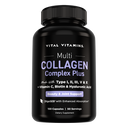
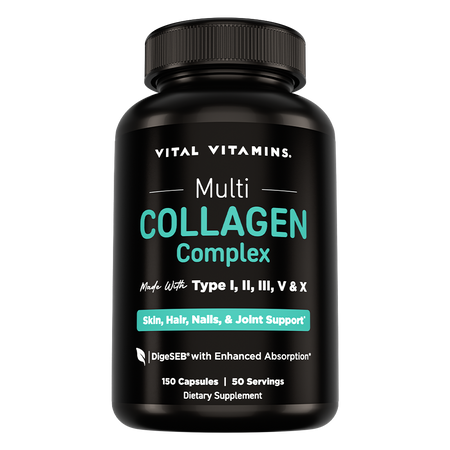
Look for non-GMO and independent testing so you know what’s in the bottle. Vital Vitamins makes that easy: our Multi Collagen Complex is non-GMO, third-party tested, GMP-compliant, and made in the USA.
A realistic, research-aligned dose
Most studies use roughly 2.5–10 g of collagen peptides per day, with some joint and muscle research using up to about 15 g.[4][7]
A format you'll stick with
The best collagen is the one you take daily — capsule or powder.
Capsule or powder?
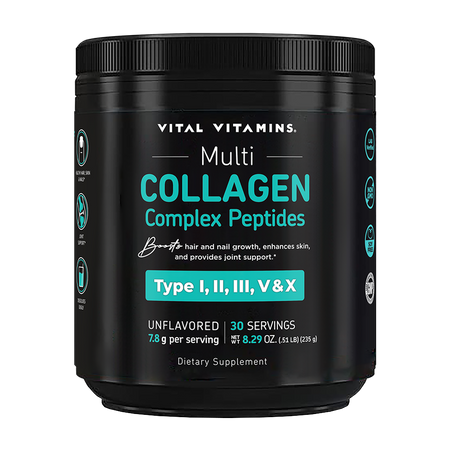
Both deliver the same kind of peptides — the difference comes down to habit and dose. Capsules are simplest for travel and a fixed daily routine. Powder lets you take a larger scoop and stir it into coffee, smoothies, or water if you prefer a higher dose or don't like pills. Neither is "better" — pick the one you'll actually keep up with. Our Multi Collagen Complex comes in both forms. The capsules deliver 1,600 mg per serving for simple daily maintenance, while the unflavored powder provides a larger 7.8 g scoop that sits squarely in the 2.5–10 g research range cited above.
How to take it and what to expect
Take collagen once daily, consistently, with or without food. Results are gradual: many people notice early changes in hair and nails around weeks 4–6, with visible skin improvements typically appearing around 8–12 weeks,[2] and measured nail effects in research at around 24 weeks.[3] Joint and connective-tissue benefits in studies build over a similar 12–24-week horizon.[6] For a full breakdown, see How Long Until Collagen Works.
Explore Collagen
Frequently asked questions
Most research uses about 2.5–10 g of collagen peptides daily, with some joint and muscle studies going up to about 15 g.[4][7] Follow the label for your specific product and keep the dose consistent.
Plan on weeks, not days — many people notice early hair and nail changes around weeks 4–6, with visible skin improvements typically around 8–12 weeks. Joint and muscle benefits in research build over 12–24 weeks. Consistency matters more than any single dose.
Collagen supplements are generally well tolerated, with no adverse events reported across reviewed trials.[4] If you're pregnant, nursing, or have a health condition, check with your healthcare provider. Note common allergens — many multi-collagen products contain fish and egg.
No. Skin gets the most attention, but the same peptides support hair, nails, joints, cartilage, and the connective tissue around your muscles. A multi-type blend is built for that whole-body support rather than skin alone.
It works for everyone. Collagen is a structural protein the entire body relies on, and the decline that comes with age affects all sexes. The research backs this up across populations — including a 24-week study in active athletes[6] and a controlled trial in older men who gained muscle and strength by pairing collagen with resistance training.[7] Collagen is often marketed toward beauty, but the biology isn't gender-specific.
The science
Studies
Oral collagen supplementation: a systematic review of dermatological applications
View sourceVitamin C: Fact Sheet for Health Professionals
View sourceA study of the decrease of skin collagen content, skin thickness, and bone mass in the postmenopausal woman
View sourceView All Studies Show fewer
Oral supplementation of specific collagen peptides has beneficial effects on human skin physiology: a double-blind, placebo-controlled study
View sourceOral supplementation with specific bioactive collagen peptides improves nail growth and reduces symptoms of brittle nails
View sourceReferences
- Iwai K, Hasegawa T, Taguchi Y (2005). Identification of food-derived collagen peptides in human blood after oral ingestion of gelatin hydrolysates. Journal of Agricultural and Food Chemistry, 53(16), 6531–6536.
- Proksch E, Segger D, Degwert J (2014). Oral supplementation of specific collagen peptides has beneficial effects on human skin physiology: a double-blind, placebo-controlled study. Skin Pharmacology and Physiology, 27(1), 47–55.
- Hexsel D, Zague V, Schunck M (2017). Oral supplementation with specific bioactive collagen peptides improves nail growth and reduces symptoms of brittle nails. Journal of Cosmetic Dermatology, 16(4), 520–526.
- Choi F, Sung C, Juhasz M (2019). Oral collagen supplementation: a systematic review of dermatological applications. Journal of Drugs in Dermatology, 18(1), 9–16.
- Brincat M, Kabalan S, Studd J (1987). A study of the decrease of skin collagen content, skin thickness, and bone mass in the postmenopausal woman. Obstetrics & Gynecology, 70(6), 840–845.
- Clark KL, Sebastianelli W, Flechsenhar KR, et al. (2008). 24-week study on the use of collagen hydrolysate as a dietary supplement in athletes with activity-related joint pain. Current Medical Research and Opinion, 24(5), 1485–1496.
- Zdzieblik D, Oesser S, Baumstark MW, Gollhofer A, König D (2015). Collagen peptide supplementation in combination with resistance training improves body composition and increases muscle strength in elderly sarcopenic men: a randomised controlled trial. British Journal of Nutrition, 114(8), 1237–1245.
Ready to start?
Daily collagen that covers the bases
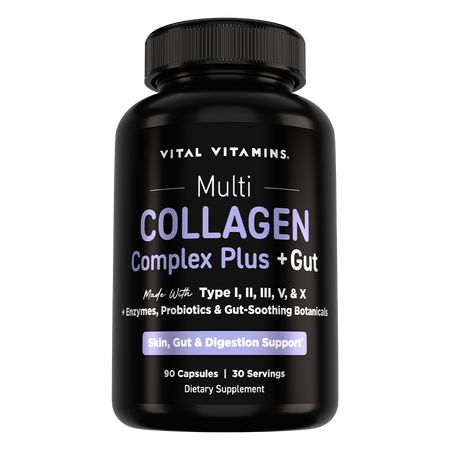
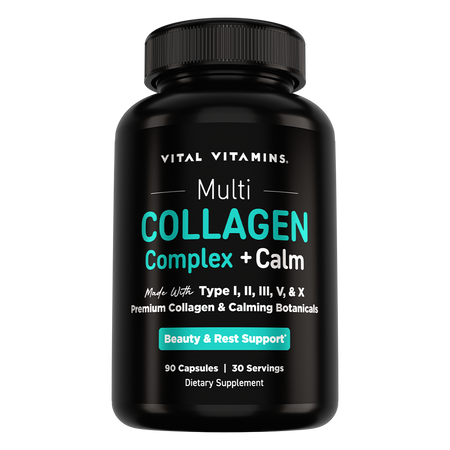
Our Multi Collagen Complex delivers five collagen types from four sources — supporting skin, hair, nails, and joints* — third-party tested, in capsule or powder. Or browse the full collagen collection to compare options.
* These statements have not been evaluated by the Food and Drug Administration. This product is not intended to diagnose, treat, cure, or prevent any disease.