
Four things decide whether an NAD+ supplement is worth buying: the form on the label, the dose per serving, what’s carrying it through digestion, and whether the manufacturer will show you third-party testing. We formulate an NAD+ supplement ourselves, so these are the criteria we use — including on our own product. They hold up whether or not you buy ours.
The single most useful habit: read the supplement facts panel instead of the front of the bottle. Most of what separates a good product from a bad one in this category is visible there.
Start with the form on the label
“NAD+ supplement” on a front label can mean at least four different molecules, and they are not interchangeable.
You’ll see NAD+ itself, nicotinamide mononucleotide (NMN), nicotinamide riboside (NR), plain nicotinamide, or a blend of several. NMN and NR are precursors — smaller molecules your body converts into NAD+ — and the NIH Office of Dietary Supplements notes they aren’t marketed or labelled as sources of niacin even though they sit in the same metabolic family. [2]
The amount of human research behind each differs sharply. A 2026 randomized trial in Nature Metabolism compared three of them head to head in 65 healthy adults over 14 days: NR at 1 g/day and NMN at 1 g/day each roughly doubled circulating NAD+, while nicotinamide at 0.5 g/day did not. [1] That’s a meaningful difference between molecules sold under broadly similar marketing.
So: turn the bottle over, find the supplement facts panel, and read what’s actually in it before you compare anything else.
Check the dose per serving, not per bottle
A product advertising 1,000 mg may be delivering that across four capsules — which makes it a very different proposition from 1,000 mg in one.
Look for two numbers together: the amount per serving, and the serving size. Then check servings per container. A 60-capsule bottle at two capsules per serving is a 30-day supply, not a 60-day one, and the cost-per-day maths changes accordingly.
Typical oral servings in this category run from 250 mg to 1,000 mg. Bigger isn’t automatically better — the published human trials don’t show dose-dependent improvement in the outcomes most people care about — but you should at least know what you’re comparing. The cleanest version of this is one capsule, one serving — nothing to multiply.
Look at what’s carrying it through digestion
This is the criterion most worth understanding, because it’s where the category makes its boldest claims and has its thinnest evidence.
Swallowed NAD+ doesn’t survive digestion intact. Enzymes in the small intestine cleave it into NMN, then NR, then nicotinamide, and those fragments are what get absorbed. [3] That’s the reason delivery systems exist in this category at all: the molecule is large and charged, and formulators are trying to protect it on the way through.
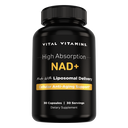
Our capsule uses sunflower seed lecithin as a liposomal carrier — a phospholipid shell built to do exactly that. Here’s where the evidence sits, and it applies to every liposomal NAD+ product on the market including ours. A 2026 crossover study reported that 14 adults taking 1,000 mg of a liposomal NAD+ preparation daily for two weeks raised intracellular NAD+ by an average of more than 64% over baseline [5] — the first human data of its kind. Read it for what it is: it wasn’t randomized, it had no placebo group, it was run by the manufacturer of the delivery technology, and it compared two liposomal preparations against each other rather than against unencapsulated NAD+. So it doesn’t establish that the liposomal shell is what made the difference. No published trial has tested that comparison head to head.
The formats you’ll see, and what to make of them
Capsules and softgels are the default: simple, stable, easy to dose consistently. Powders give you flexibility on serving size and are easier to stack into a drink, at the cost of taste and a bit more room for error in measuring. Sublingual tablets are designed to dissolve under the tongue on the theory that absorption through the mouth bypasses the gut.
For all of these, the useful questions are the same four this article is built on. A format doesn’t override what’s on the panel.
The formats we’d be skeptical of: patches and nasal sprays
NAD+ patches and nasal sprays are sold on the promise of skipping digestion entirely. We looked for published human data supporting either and found none.
There is animal and cell-culture work on intranasal NAD delivery, and there are plenty of product pages making confident claims. What there isn’t, as far as we can find, is a human trial. Absence of evidence isn’t proof a format doesn’t work — but when you’re paying a premium specifically for a delivery claim, the burden should be on the claim.
If you’re drawn to one of these, ask the seller for the human study. The answer is informative either way.
Third-party testing and where it’s made
Ask whether the product is third-party tested, and whether the company will actually show you a certificate of analysis.
Third-party testing means an independent lab has verified identity and potency — that what’s on the panel is what’s in the capsule. “GMP compliant” refers to manufacturing process controls, which matters but is a different thing; GMP doesn’t verify the contents of a specific batch. Country of manufacture is worth knowing for the same reason.
Ours is third-party tested, GMP compliant, made in the USA, and non-GMO and soy free.
Label claims that should make you skeptical
Certain phrases tell you more about a company’s standards than its ingredients do.
Be wary of anything promising reversal — “reverses aging,” “turns back the clock.” Be wary of lifespan language: the dramatic longevity findings in this field come overwhelmingly from animal models, not people. Be wary of “clinically proven,” which is a much stronger word than the evidence in this category supports. Be wary of a specific decline statistic — “NAD+ drops 50% by age 50” and its variants — because we went looking for a peer-reviewed source for figures like that and couldn’t find one.
What we make, and where it lands on these criteria
Against the same four criteria, honestly applied.
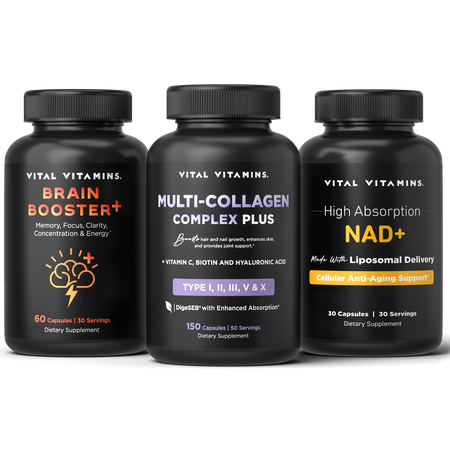
Dose per serving: 500 mg of NAD+ in a single capsule, 30 capsules per bottle, 30 servings. One capsule is one serving, so the panel maths is straightforward and the cost per day is the price of the bottle divided by thirty.
Testing: third-party tested, GMP compliant, made in the USA, non-GMO and soy free.
Carrier: sunflower seed lecithin, liposomal. A formulation choice with a clear rationale and, as above, one small uncontrolled human study behind the approach rather than a head-to-head trial.
Form: NAD+ itself, 500 mg. The deeper body of human trial evidence in this category sits with the precursors NR and NMN rather than with NAD+ — a 2023 review of 25 human studies of NR is the most thorough body of work available, and nothing comparable exists for oral NAD+ yet. [4] We’d rather you hear that from us than find it out later.
That’s the product, described the way we’d want a product described to us.*
*These statements have not been evaluated by the Food and Drug Administration. This product is not intended to diagnose, treat, cure, or prevent any disease.