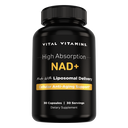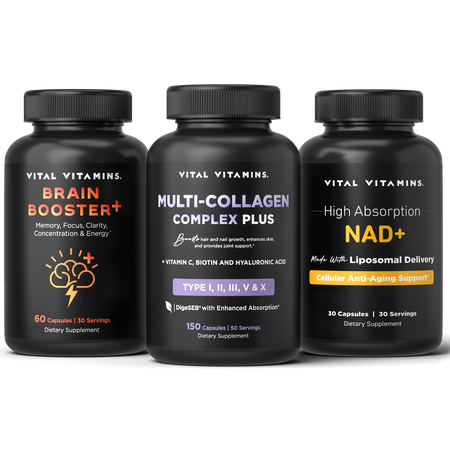

Take NAD+ once daily with food. Our capsule provides 500 mg per serving, and there’s no reason to double up — the labelled serving is the one the product is built around. Across the published human research on this category, doses have run from 100 mg to 2,000 mg per day, though almost all of that work tested the precursors NR and NMN rather than NAD+ itself. [1,3]
It’s generally well tolerated. In trials of both precursors, adverse effects were no more common than with placebo. [1,4]
How much NAD+ should you take per day?
Follow the label on whatever product you own. Ours provides 500 mg of NAD+ in a single capsule, taken once a day.* Most oral products in this category land between 250 mg and 1,000 mg per serving.
The number on the front of the bottle isn’t the number that matters, though — serving size is. A product advertising “1,000 mg” may be delivering it across two or four capsules, which changes both the cost per day and how many things you’re swallowing. Check the supplement facts panel and compare per serving, not per bottle.
There’s also no established daily requirement for NAD+ the way there is for a vitamin. You have a requirement for the B3 family that your body builds NAD+ from, not for the coenzyme itself. So the doses you see on shelves come from what manufacturers have chosen and what dose-ranging research on related molecules has tested, not from an official recommended intake.
What doses has the research actually used?
Here’s where it pays to be precise about which molecule was tested, because the published dose-ranging work is on the precursors rather than on NAD+.
A 2023 review in Science Advances covering 25 human studies of nicotinamide riboside found doses ranging from 100 to 2,000 mg per day, over durations from a few hours to six months. [1] On the NMN side, a 2022 randomized placebo-controlled trial in npj Aging used 250 mg daily in healthy older men for up to 12 weeks, [2] and a 2023 randomized trial in GeroScience compared 300, 600 and 900 mg daily in 80 healthy adults aged 40–65. [3]
What those trials consistently show is that the precursors raise NAD+ levels in blood. A 2026 head-to-head trial in Nature Metabolism found NR and NMN each roughly doubled circulating NAD+ in 65 healthy adults over 14 days. [7] What they don’t consistently show is a difference in how people feel or perform — and we’d rather say that than imply the dose research proves more than it does.
When should you take NAD+?
Morning, with a meal, is the simplest answer, and consistency matters more than the clock.
There’s no published human evidence that one time of day works better than another for an oral NAD+ supplement. What the research does suggest is that steady daily intake is what moves NAD+ levels — the trials above dosed once daily over weeks, not sporadically. [2,3] A capsule you actually remember beats a theoretically optimal time you skip twice a week.
If mornings don’t work for you, pick whichever meal you never miss and anchor it there.
Do you need to take it with food?
Yes — take it with food. That’s the labelled direction, and it’s the practical answer to the most common complaint people have when starting.
Supplements taken on an empty stomach are more likely to cause mild nausea or stomach discomfort, and this category is no exception. Taking the capsule alongside a meal is the first thing to try if it doesn’t sit well.
What are the side effects of NAD+ supplements?
Mild and uncommon, based on the human trial data that exists — which, again, is mostly on the precursors.
A 2026 systematic review and meta-analysis in Nutrients pooled 15 randomized trials of oral NMN covering 383 participants at doses from 250 to 2,000 mg per day for 14 days to 24 weeks. It reported favourable tolerability, with no clear increase in adverse events and no hepatic biochemical abnormalities — no significant difference from placebo in adverse events, serious adverse events, or withdrawals. [4]
The 2023 Science Advances review of nicotinamide riboside reached a similar conclusion across its 25 studies: no detectable differences from placebo in liver or kidney markers, potassium, lipids, blood pressure or heart rate, and no serious adverse events reported in any trial. [1] Even at the high end — a 2023 randomized double-blind trial in Nature Communications gave 3,000 mg of NR daily for four weeks — the dose was well tolerated, though that trial was run in people with Parkinson’s disease rather than in healthy adults. [5]
One scope limit worth stating: every one of those trials ran 24 weeks or less, and most ran 12 or fewer. There is no long-term human data in this category yet.
Who should check with a doctor first?
If you’re pregnant or breastfeeding, taking prescription medication, or managing any health condition, talk to your doctor or pharmacist before starting — the same advice that applies to any new supplement.
That isn’t boilerplate here. The published trials in this category were run in defined populations over defined periods, which means they can’t tell you how a supplement interacts with your particular medication or situation. Your pharmacist can look at your actual list. We can’t.
What to expect in the first few weeks
Most likely nothing you can feel, and that’s not a failure of the product.
The human trials in this category are much better at demonstrating that a supplement raises NAD+ levels in blood than at demonstrating that people notice a difference. The 2026 Nutrients meta-analysis of NMN found no significant effect on body weight, BMI, fasting glucose, HbA1c or lipid profile. [4] The 2023 review of NR concluded that across 25 studies there were few clinically relevant effects, and noted a tendency in the literature to exaggerate the robustness of what was reported. [1]
So set expectations accordingly: this is a daily habit with a mechanistic rationale, not something you take to feel different by Friday. Individual results vary, and anyone promising you a timeline is telling you something the research hasn’t established.
The approach we don’t recommend: megadosing
Taking several servings a day in the hope of a bigger effect isn’t supported by the evidence.
Higher doses have been tested in the precursor literature — up to 2,000 mg daily of NR across the reviewed studies, and 3,000 mg in one short high-dose safety trial — and they were tolerated. [1,5] Tolerated is not the same as better. Those same reviews found no dose-dependent improvement in the outcomes that matter to most people. You’d be spending more, swallowing more, and going beyond the serving the product was formulated around, on the strength of an assumption rather than a finding.
There’s also no published basis for cycling on and off. If you take it, take it consistently at the labelled serving.
Does more do more?
No — not on the evidence available. The useful comparison between products isn’t which number is biggest, it’s dose combined with form.
Different molecules behave differently. Swallowed NAD+ is broken down in the small intestine into smaller precursors before anything is absorbed, [6] which is why a milligram of one form isn’t interchangeable with a milligram of another. Comparing a 1,000 mg product to a 500 mg product tells you very little if they contain different things.
*These statements have not been evaluated by the Food and Drug Administration. This product is not intended to diagnose, treat, cure, or prevent any disease.