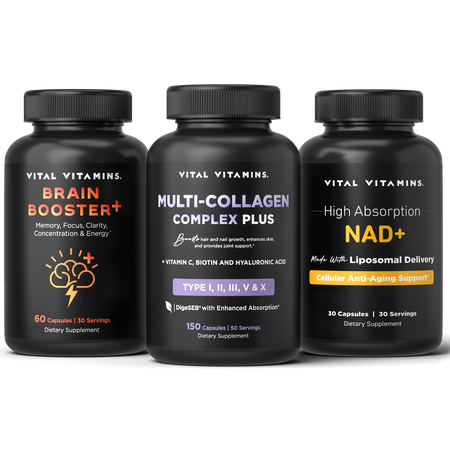

Search "best time to take brain supplements" and you'll find confident answers pointing in opposite directions — some pages swear by mornings, others insist on night. We get a version of this question about our own Brain Booster+ often enough that it's worth answering directly: here's what actually changes based on the clock, what doesn't, and how to build a routine you'll actually stick with.
There's no single best hour to take a brain health supplement. What rises and falls throughout the day is your own natural alertness and energy — not how a caffeine-free formula like Brain Booster+ works. The variable that actually drives results is taking it every day, so the best time is whichever one you'll realistically remember.
Does morning or night change how a brain supplement works?
For a caffeine-free formula like Brain Booster+: no, not in any way that's well established. There isn't strong published research showing that a specific hour of the day changes how a multi-ingredient nootropic blend performs, the way timing can matter for a fast-acting stimulant. Most of what goes into a brain health routine — B vitamins, choline, adaptogenic plant extracts like ginkgo leaf and rhodiola root, and mushroom extracts like lion's mane — is meant to be taken consistently as part of a daily habit, supporting memory, focus, clarity, and concentration over time.*
Why your alertness naturally rises and falls during the day
Even though the supplement itself isn't on a clock, you are — your brain's natural alertness and focus shift across a 24-hour cycle, which is part of why some hours you feel sharper than others. This pattern is governed by your circadian rhythm, the internal biological clock that regulates when you tend to feel awake, focused, or ready to wind down, running on a roughly 24-hour cycle. In a 2012 peer-review of circadian research on cognition, attention, working memory, and executive function (the mental skills involved in planning and staying on task) were shown to follow a predictable daily pattern — generally lower overnight and in the early morning, and higher through the day, with the exact peak varying by person [1]. That daily rhythm is about your brain's own baseline state, not about the supplement. Taking Brain Booster+ earlier or later in the day doesn't shift where you land on that curve — it just means you're supplying the same daily nutrients regardless of where your natural alertness happens to be that day.
The morning cortisol connection — and why it isn't a requirement
Many people naturally feel a bit sharper for a short window right after waking, and that's a real physiological pattern — but it doesn't mean a brain supplement has to be taken inside that window to work. The effect comes from cortisol, a hormone your body releases in a natural surge within the first 30 to 45 minutes after waking, known in the research as the cortisol awakening response [2]. That morning rise is part of why mornings can feel like a natural energy peak for a lot of people, but it's your body's own rhythm doing that work, not something Brain Booster+ is timed against. If mornings happen to be your best focus window, that's a perfectly good reason to build the habit there — it's a convenience choice, not a requirement of how the formula works.
Why a caffeine-free formula like Brain Booster+ doesn't come with a cutoff time
Stimulant-based nootropics usually need to be taken by early-to-mid afternoon to protect nighttime sleep — Brain Booster+ doesn't carry that restriction, because it's caffeine-free.* Caffeine has a half-life long enough that a dose taken in the afternoon can still be affecting you well into the evening. A 2013 randomized, placebo-controlled study found that a standard dose of caffeine taken even six hours before bedtime still measurably disrupted sleep compared with placebo [3]. That's the reason so much timing advice for stimulant-based focus products revolves around a strict "cut off by early afternoon" rule. Brain Booster+ skips that problem — with no caffeine, it doesn't carry a sleep-protective cutoff to plan around, whether you prefer a morning, midday, or evening capsule. If you're weighing Brain Booster+ against other nootropic options, including ones that do rely on caffeine, our Best Nootropics for Focus and Memory article breaks down how different formulas compare.
What timing can't do for you
Switching the hour you take Brain Booster+ won't substitute for the habit that actually drives results: taking it daily, for long enough to matter. It's worth being clear about the limits here — no time of day makes a nootropic blend faster-acting or stronger, and no single dose, morning or night, replaces the basics that shape brain health generally, like consistent sleep, movement, and hydration. Brain Booster+ is meant to be a supportive daily habit,* not a shortcut around any of those. The label's own guidance reflects that: it's meant to be used for three or more months, and individual timelines and results can vary since everyone's starting point and routine are different. General federal guidance on dietary supplements echoes the same point — showing up consistently, not chasing an ideal hour, is the variable that matters most for getting anything out of a daily supplement routine [4]. If you're curious what a realistic timeline for noticing anything looks like, our How Long Until Brain Supplements Start Working? article covers that in more depth.
Building a Brain Booster+ routine that actually sticks
The easiest way to stay consistent is to anchor the habit to something you already do every day, rather than relying on remembering it cold. A simple way to set that up:
- Pick one anchor moment you already do daily — breakfast, brushing your teeth, or your first cup of coffee — and take the brain supplement right alongside it, at the same point every day.
- Take the two daily capsules with a meal or snack that includes some healthy fat, along with a full glass of water, per the label directions.
- Keep the bottle somewhere you'll see it — next to the coffee maker, the toothbrush, or your desk — rather than in a cabinet you rarely open.
- If you miss a day, just take the next dose on schedule. Don't double up to "catch up" — consistency going forward matters more than making up a missed day.