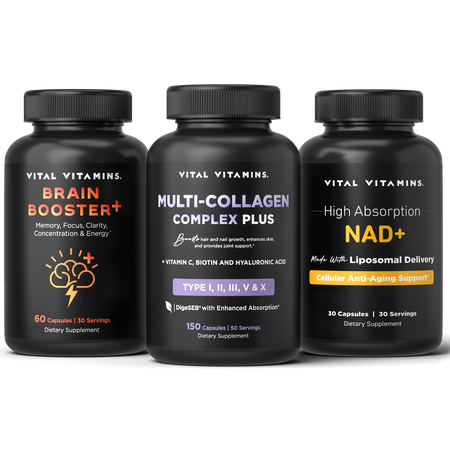

Studying for an exam, prepping for a big presentation, or just trying to remember where you left your keys — everyday memory and concentration questions come up constantly, and the supplement aisle oversells what any capsule can do. This guide covers what research actually supports for everyday memory and focus, the ingredients most consistently linked to that support, and where our own Brain Booster+ fits in.
Quick answer: no supplement replaces sleep, a balanced diet, or mental engagement for memory and focus, but a specific set of ingredients — Bacopa monnieri, Ginkgo biloba, Lion's Mane mushroom, grape seed extract, blueberry-derived anthocyanins, and vitamin B12 — have research behind their role in supporting memory and concentration as part of a broader routine.*
What actually supports memory and concentration
Three things reliably support everyday memory and concentration: consistent sleep, a nutrient-dense diet, and ongoing mental engagement — with specific plant and nutrient compounds able to provide additional support on top of that foundation.* Memory and concentration aren't single skills; they depend on attention, working memory, and long-term recall working together, and each responds to different daily inputs. Skipping sleep undercuts memory consolidation — the process by which the brain files short-term experiences into longer-term storage — regardless of what's in your supplement cabinet. A nutrient gap can also play a role in everyday forgetfulness or trouble concentrating, which is part of why nutrient-focused ingredients show up throughout the research below. That's the order this guide follows: the fundamentals first, then the ingredients with research behind them, then where a formulated supplement like Brain Booster+ fits in.
The key ingredients researchers link to memory and focus support
Six ingredients show up most consistently in published research on memory and concentration: Bacopa monnieri, Ginkgo biloba, Lion's Mane mushroom, grape seed extract, blueberry-derived anthocyanins, and vitamin B12. Here's what the research on each one actually found:, in plain terms. For a closer look at nootropic-specific ingredients beyond this list, see our guide to Best Nootropics for Focus and Memory.
- Bacopa monnieri (an Ayurvedic herb sometimes called Brahmi): in a 2001 randomized, placebo-controlled trial, taking a Bacopa monnieri extract daily for 12 weeks was associated with improved learning rate and memory consolidation in healthy adults, compared to placebo [1].
- Ginkgo biloba (an extract from the ginkgo tree's leaves, used in traditional and modern herbal preparations): in a 2000 trial, cognitively healthy older adults ages 55 to 86 who took a Ginkgo biloba extract for six weeks showed faster performance on select cognitive tasks compared to their own baselinecompared with placebo[1.1] [2].
- Lion's Mane mushroom (Hericium erinaceus, an edible fungus studied for its role in brain-supportive pathways): in a 2009 double-blind trial, older adults with age-related cognitive changes[2.1] who took a Lion's Mane extract daily for 16 weeks scored better on cognitive assessments than the placebo group [3].
- Grape seed extract (a concentrated source of proanthocyanidins, a class of antioxidant plant compounds): a 2020 randomized, placebo-controlled trial found grape seed polyphenol extract was linked to improvements in reaction time and psychomotor performance versus placebo in healthy young adults — though the effect wasn't consistent across every cognitive measure tested, a useful reminder that ingredients don't work identically for every age group or outcome [4].
- Blueberry-derived anthocyanins (the pigments that give blueberries their color, also studied as antioxidants): in a 2010 trial, older adults who added a blueberry-derived supplement to their daily routine for 12 weeks showed improved paired-associate learning and word-list recall compared to their own starting point[3.1] [5].
- Vitamin B12: a 2012 research review found that B12 plays a well-established role in normal nervous system function, and that low B12 status is associated with everyday cognitive changes — one reason B-vitamin status is worth paying attention to as part of a memory-support routine [6].
What memory supplements don't do
No supplement can — including ours — replaces sleep, a balanced diet, or regular mental engagement, and none of the ingredients above are a substitute for a medical evaluation if you're experiencing a memory or concentration change that concerns you. Supplements can provide targeted nutritional and botanical support* for everyday memory and focus, but that support works on top of the fundamentals, not instead of them. If a memory or concentration change is sudden, severe, or getting worse rather than staying steady, that's a conversation for a doctor, not a supplement aisle. That distinction matters because "memory support" and medical care are different categories entirely: dietary supplements are intended to support normal body structure and function, not to diagnose, treat, cure, or prevent any disease.* Everyday forgetfulness, trouble concentrating during a long workday, or wanting sharper recall while studying are the kinds of ordinary, non-medical scenarios this guide — and Brain Booster+ — are built for. If what you're actually noticing is more like mental fog than memory specifically, Brain Fog: Causes and What Actually Helps covers that distinction in more depth.
The approach we don't recommend: relying on caffeine and stimulants alone
Reaching for coffee, energy drinks, or other stimulants as the only strategy for focus works in the short term and stops working the way you want it to over time. Stimulants raise alertness through a different pathway than the nutrients and botanicals studied for memory consolidation and sustained attention above — it's a different job entirely, not an interchangeable one. Leaning on stimulants alone can also crowd out the fundamentals: using caffeine to push through sleep debt masks the symptom (feeling tired) instead of addressing the cause (not enough sleep), which is exactly the gap the honest-limits point above is getting atwhich is exactly the gap this guide keeps coming back to. Brain Booster+ is formulated to be caffeine-free for that reason — it's built to work alongside a normal sleep and nutrition routine, not to substitute for one before a stimulant crash later in the day.
What we look for in a memory and concentration supplement — including our own
We've spent years formulating supplements for memory and focus at VIVVital Vitamins, so here's what we actually look for in a memory-support product — including our own Brain Booster+. Three things matter most: ingredients backed by published research, a formula that pairs memory-specific and focus-specific botanicals rather than relying on a single compound, and a clean label without unnecessary stimulants or fillers.
Brain Booster+ is built around five targeted blends. The Memory Blend combines Ginkgo Leaf, Rhodiola Root Extract, a soy-derived phosphatidylserine extract, and Lion's Mane Mushroom to support memory specifically.* The Focus Blend pairs Grape Seed Extract, whole-plant Bacopa extract, and Lion's Mane to promote sharper focus.* The Concentration Blend layers DMAE, Lion's Mane, Bilberry Fruit, Rhodiola Root Extract, Phosphatidylcholine from soy lecithin, and Blueberry Fruit Extract to help support concentration.* A Clarity Blend and a Neuro Blend round out the formula with additional botanicals and amino acid derivatives. The capsule also provides Vitamin B6, Folate, Vitamin B12, Choline, and Magnesium (as magnesium oxide) to round out the nutritional side of the formula.*
Lifestyle habits that support memory and concentration alongside supplementation
Sleep, diet, and mental engagement do more for everyday memory and concentration than any single ingredient, which is why they come first in any real routine. Sleep is when the brain consolidates the day's information into longer-term memory, so consistently short or interrupted sleep undercuts recall no matter what else you're doing. A diet that includes enough B vitamins, healthy fats, and antioxidant-rich produce — the same nutrient categories showing up in the research above — supports the nervous system doing that consolidation work.* Mental engagement matters too: learning a new skill, reading, or simply varying your routine keeps attention and working memory active, the same way movement keeps muscles capable. None of this is exotic advice, but it's the piece that gets skipped in favor of the supplement itself — and skipping it is one of the most common reasons a memory supplement underperforms.