Maybe you've noticed your skin doesn't bounce back the way it used to, or dry patches have started showing up where they never did before. You're not alone. These are some of the most common signs that your body's natural collagen production is slowing down — and the good news is, understanding what's happening beneath the surface is the first step toward supporting your skin from the inside out.
Collagen makes up about 30 percent of your body's total protein, and Type I collagen provides the structural foundation for your skin.1 Production drops roughly 1 percent each year starting in your mid-twenties, and the decline tends to accelerate after 30. That gradual loss shows up as fine lines, reduced elasticity, and drier skin.
This guide breaks down what collagen actually does for your skin, what the research shows about supplementation, and the daily habits that help protect the collagen you already have.
Key Takeaways
-
Collagen accounts for about 30% of your body's protein, and Type I provides the primary structural support for skin — roughly 80% of skin collagen and 90% of total body collagen.
-
Randomized clinical trials show oral hydrolyzed collagen (0.3–8 kDa molecular weight) can improve skin hydration and elasticity within 8–12 weeks at doses of 2.5–10 grams per day.2
-
Bioactive dipeptides Pro-Hyp and Hyp-Gly reach peak blood levels within 1–2 hours of ingestion and stimulate fibroblasts to produce new dermal collagen.3
-
Topical collagen hydrates the skin's outer layer, but has limited bioavailability compared with oral peptides.
-
Daily habits matter: SPF 30+, avoiding tobacco, limiting added sugars to under 10% of calories, eating vitamin C, zinc, and copper-rich foods, and exercising 150 minutes per week all support collagen health.
What Is Collagen?
Collagen is the skin's primary structural protein, produced by cells called fibroblasts deep in the dermis. Think of it as the scaffolding that keeps everything firm, smooth, and hydrated. To build new collagen, your body needs amino acid building blocks like glycine and proline, helper minerals like copper and zinc, and antioxidants — especially vitamin C — that protect the process.1
The Major Collagen Types
There are at least 28 types of collagen, but a handful do most of the heavy lifting. Here's what to know about the types most relevant to your skin and body:
-
Type I makes up about 90% of body collagen and roughly 80% of skin collagen. It provides tensile strength to the dermis, tendons, and bone.
-
Type II dominates cartilage (90–95% of its extracellular matrix) and supports joint function and load distribution.
-
Type III accounts for about 15% of total body collagen and maintains structural integrity in flexible tissues like muscles and arterial walls.
-
Type IV is a nonfibrillar collagen that contributes to the architecture of the basement membrane — the boundary between your epidermis and dermis.
-
Type V plays a regulatory role in fibril assembly and appears in the cornea, certain skin layers, and hair.
Together, Types I, II, and III make up 80–90% of all collagen in your body.2 That's why a multi-collagen approach — one that includes several types rather than just one — can offer broader structural support.
What Collagen Does in Your Skin
Your skin is your body's largest organ, and its dermis relies on a network of collagen, elastin, and hyaluronic acid to stay firm and hydrated. Fibroblasts produce most of this dermal collagen, building and maintaining the extracellular matrix — the framework that gives skin its structure and strength.
Collagen also interacts with cell receptors, sending signals that guide how cells grow, move, and mature. When the matrix is strong, skin stays resilient. When collagen levels decline — due to age, UV exposure, high sugar intake, hormonal shifts, or environmental stress — fine lines, sagging, and dryness follow.
How Collagen Supports Skin Elasticity
Elastic skin stretches and snaps back. Collagen strengthens that recoil by reinforcing the matrix that anchors every cell.
Stimulating Fibroblast Activity
Hydrolyzed collagen peptides can stimulate fibroblast activity in the dermis, encouraging the production of new collagen.3 Fibroblasts are the cells responsible for synthesizing collagen and building the extracellular matrix — the deeper support network that determines how firm and elastic your skin feels.
When you take oral collagen supplements, the peptides supply amino acids like proline and hydroxyproline that fibroblasts use as raw material. Bioactive peptides from hydrolyzed collagen may also trigger signaling pathways that tell fibroblasts to ramp up production. A diet rich in fruits and vegetables supports this process, and strong sun protection limits the UV damage that breaks collagen down.1
Strengthening Skin Structure
Type I collagen molecules twist into triple-helix fibrils — tightly wound protein structures that resist stretching and give skin its mechanical strength. Chemical processes like hydroxylation and cross-linking help these fibrils hold up under daily wear.
Clinical studies show that oral hydrolyzed collagen can raise collagen content, density, and synthesis in skin tissue.2 Peptides are absorbed into the bloodstream, and tissue analyses have detected their presence in the dermis. This suggests that supplements may directly enhance fibroblast output, improving fibril formation and overall structural strength.
Reducing the Appearance of Wrinkles
Randomized controlled trials have found that oral collagen supplementation can improve skin hydration, texture, and wrinkle depth. Collagen peptides with higher tripeptide content have shown particular promise, lowering both wrinkle number and depth across multiple study populations.
In one trial, a formula providing 2.5 grams of collagen peptides alongside vitamin C, zinc, and biotin reduced visible aging signs in women aged 35 and older. Objective measures using cutometry — an instrument that quantifies elastic recoil — confirmed higher elasticity and smoother skin surfaces. Improvements often appeared by 8–12 weeks, with some benefits lasting several weeks after stopping supplementation.4
How Collagen Enhances Skin Hydration
Think of collagen as the scaffolding that holds water-binding molecules in place. When the frame is strong, the surface stays supple.
Collagen stabilizes the extracellular matrix and supports fibroblast activity. These actions appear to increase glycosaminoglycans — including hyaluronic acid — which hold water in the dermis. Randomized trials using corneometry and biopsy suggest that oral collagen peptides raise stratum corneum hydration and improve matrix density, though effects can vary by dose and study design.2
Retaining Moisture in the Skin
Hydrolyzed collagen supplementation has increased skin hydration in multiple clinical studies. A stronger dermal structure helps the stratum corneum — the outermost skin layer — hold water more effectively and resist the roughness and dryness that come with age.
In one study, fish-derived hydrolyzed collagen improved facial hydration, radiance, and firmness in women aged 45–60 after 12 weeks.5 Peptide formulas with a 15% tripeptide fraction raised water content in the outer skin layer by week twelve. Hyaluronic acid in the matrix naturally binds large amounts of water, and a stronger collagen network enhances that retention. Longer-term oral supplementation has produced more durable hydration outcomes in repeated trials.
Improving Skin Barrier Function
Higher hydration strengthens the skin barrier, reducing moisture loss and making skin less reactive to environmental irritants. Collagen peptides — including the bioactive dipeptides Pro-Hyp and Hyp-Gly — have been linked to both higher water content and improved elasticity in the epidermis.3
With greater collagen content and density after supplementation, the barrier holds up better against daily stress. Clinical measures often show lower transepidermal water loss, while smoother texture and improved firmness point to a sturdier defense against irritants and allergens.
Benefits of Collagen Supplementation
Across randomized trials and systematic reviews, oral collagen has been consistently associated with improvements in skin elasticity and hydration. Researchers attribute these outcomes to increased fibroblast activity and higher levels of dermal proteins confirmed through tissue sampling and protein assays.4
Increased Skin Elasticity
A 12-week trial showed significant gains in skin elasticity in women aged 35 and older taking collagen peptides. Participants maintained benefits during a four-week follow-up period after stopping supplementation.4
In another randomized study of 85 women aged 45–60, 10 grams per day of hydrolyzed collagen produced measurable increases in elasticity. Collagen peptides reach peak blood levels within one to two hours after ingestion — a window that may directly support effects on dermal structure. Their amino acid composition closely matches human collagen, which appears to support integration and stimulate fibroblast activity.
Improved Hydration Levels
Clinical trials consistently link collagen supplements with better skin hydration.4 Hydrolyzed collagen containing Pro-Hyp and Hyp-Gly increased hydration in healthy Chinese women, ages 37–48, over eight weeks.
Peptides with 15% tripeptide content raised stratum corneum moisture by week twelve in healthy Korean adults. Marine and porcine collagen at 10 grams daily improved hydration in Japanese women, ages 40–59, within eight weeks. In women ages 35–55, collagen peptides improved moisture levels and reduced transepidermal water loss by week eight. These results are particularly relevant for anyone experiencing dryness, sagging, or early fine lines.5
Reduction in Visible Aging Signs
Oral collagen peptides have significantly reduced visible aging signs in women 35 and older across multiple randomized trials. After 12 weeks, studies show fewer wrinkles and improved texture. Both objective instruments and participant self-reports confirm gains in hydration, elasticity, surface smoothness, and dermal density.4
Formulas that combine collagen peptides with vitamin C, zinc, and biotin appear to boost collagen synthesis through increased fibroblast activity and matrix support. Improvements have persisted during follow-up periods after stopping supplementation, with the most pronounced benefits appearing in participants showing age-related changes.2
Forms of Collagen for Skin Benefits
How you take collagen matters. Different delivery methods affect absorption, bioavailability, and results.
Hydrolyzed Collagen (Collagen Peptides)
Hydrolyzed collagen — often labeled as collagen peptides — has the strongest clinical support for reducing wrinkle formation and improving skin elasticity and hydration.5 Hydrolysis breaks collagen into small peptides that your body can digest and absorb more efficiently. Blood levels typically peak one to two hours after a dose.
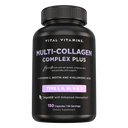
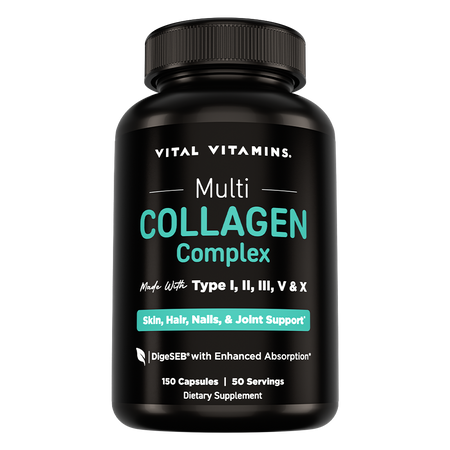
Peptide molecular weight usually ranges from 0.3 to 8 kDa, with lower weights often showing greater bioactivity. Vital Vitamins Multi Collagen Complex is formulated with hydrolyzed peptides from multiple sources, providing Types I, II, III, V, and X for comprehensive support.
Clinical results at a glance:
-
10 g/day for 12 weeks improved facial wrinkles, elasticity, hydration, and radiance in women aged 45–60.5
-
2.5 g/day for 8 weeks improved hydration, elasticity, and roughness in women aged 37–48.2
-
5 g/day for 8 weeks increased moisture, reduced wrinkle area, and lowered roughness — with greater effects from formulas higher in dipeptides.
Low molecular weight peptides and dipeptides appear to drive these outcomes through faster absorption and higher bioactivity.
Topical Collagen Products
Many creams and serums include collagen from bovine, porcine, or marine sources. These products primarily hydrate the stratum corneum — the skin's outermost layer. However, bioavailability is limited compared with oral collagen peptides, meaning less of the collagen actually reaches the deeper dermal layers where structural support is built.12
Collagen also appears in dermal fillers (for lines and volume loss), wound-healing dressings, periodontal care, and vascular grafts — but these are clinical applications rather than daily skincare.
Collagen-Rich Foods
Collagen-rich foods supply the amino acids and micronutrients your body needs for collagen synthesis. They support skin elasticity and hydration through proline, glycine, vitamin C, zinc, and copper.1
Vitamin C sources (a critical cofactor for collagen formation): oranges, strawberries, bell peppers, broccoli, Brussels sprouts, and potatoes. Aim for one citrus fruit and one bell pepper daily.
Proline sources (a principal amino acid in collagen): mushrooms, cabbage, and asparagus. Add sautéed mushrooms or steamed asparagus a few times per week.
Glycine sources (supports triple-helix stability): red meat, turkey, chicken, pork skin, peanuts, and granola. Include lean poultry or red meat two to three times per week.
Zinc sources (needed for collagen-processing enzymes): oysters, red meat, poultry, beans, chickpeas, nuts, broccoli, leafy greens, and whole grains.
Copper sources (aids collagen cross-linking): liver, lobster, oysters, shiitake mushrooms, nuts, seeds, leafy greens, tofu, and dark chocolate. One to two servings per week is sufficient.4
Fish and egg whites offer high-quality protein and amino acids that favor collagen production. Include fish twice weekly and use egg whites in recipes to diversify your amino acid intake.
A balanced weekly meal plan that mixes fruits, vegetables, legumes, whole grains, fish, and lean meats will cover vitamin C, proline, glycine, zinc, and copper — giving your body the full toolkit for collagen synthesis.
Lifestyle Habits to Protect Your Natural Collagen
Daily choices shape how much collagen your skin retains over time. Evidence from clinical trials and lab studies shows that targeted habits can lower collagen-degrading enzymes and support fibroblast activity.
Wear Sunscreen Every Day
Ultraviolet radiation is the single biggest external driver of collagen breakdown.6 Apply broad-spectrum sunscreen with SPF 30 or higher daily — even on cloudy days — to reduce photoaging. Wear protective clothing like wide-brim hats and UV-filtering sunglasses, and limit direct sun exposure during midday hours. Antioxidants from food can also help buffer the oxidative stress linked to UV exposure.7
Eat an Antioxidant-Rich Diet
Oranges, almonds, and oysters provide vitamin C, proline, and lysine — key nutrients for collagen synthesis and skin firmness.8 Vitamins A, C, and E neutralize free radicals and reduce the formation of advanced glycation end products (AGEs), which stiffen and weaken collagen fibers.
Regular intake of salmon and other omega-3-rich foods may lower inflammation and support skin hydration. Diets rich in fruits, vegetables, nuts, and fatty fish consistently align with healthier, more resilient skin.
Minimize Collagen-Damaging Habits
Small, consistent changes add up. Here are the habits most closely linked to collagen preservation:
-
Quit tobacco use. Smoking decreases collagen synthesis and impairs wound healing. Nicotine restricts blood vessels, cutting oxygen and nutrient delivery to skin and impairing fibroblast function.
-
Limit added sugars and refined carbohydrates. High intake promotes AGE formation, which cross-links collagen fibers and weakens tissue. Aim for less than 10% of daily calories from added sugars.
-
Apply SPF 30+ daily. UV radiation breaks down dermal collagen and accelerates visible aging. Protective clothing and avoiding peak sun hours compound the benefit.
-
Reduce processed food and excess alcohol. Both raise inflammation and impair skin repair. Whole foods rich in vitamin C and polyphenols support extracellular matrix stability.
-
Minimize pollutant exposure. Fine particulate matter and traffic-related toxins promote collagen degradation. Indoor air filtration and consistent cleansing help reduce deposition on skin.
-
Stay active — aim for at least 150 minutes of aerobic exercise per week. Improved circulation delivers oxygen and nutrients to fibroblasts, and exercise may support new collagen synthesis and tissue remodeling.
-
Prioritize sleep and stress management. Chronic stress alters hormonal balance and may impair collagen integrity. Target seven to nine hours of sleep per night and practice regular relaxation techniques.
The Bottom Line
Type I collagen is your skin's primary structural protein. It supports fibroblast activity, builds strong dermal fibrils, and improves skin elasticity on objective testing. Collagen peptides have improved skin moisture and reduced water loss in controlled clinical trials. Supporting nutrients like vitamin C, zinc, and copper enable natural collagen synthesis, while steady habits — daily sunscreen, a produce-rich diet, consistent exercise, and quality sleep — help preserve what you already have.
If you're ready to make collagen part of your routine, explore the full Vital Vitamins collagen lineup and find the formula that fits your goals.
As always, follow recommended serving guidelines and speak with a healthcare professional if you're pregnant, nursing, taking medications, or have allergies. This content is for general information and is not a substitute for medical advice.
References
Footnotes