Maybe you've noticed fine lines creeping in, or your joints feel a little stiffer after a workout than they used to. You're not alone. These are some of the most common signs that your body's natural collagen production is slowing down — and the good news is, understanding what's happening is the first step toward supporting your body through it.
Collagen production drops by about 1% each year starting in your mid-twenties, and the decline tends to accelerate after 30.1 That gradual loss shows up as thinner skin, reduced elasticity, and slower recovery. This guide breaks down the main types of collagen, what the research actually shows about supplementation, and how to make collagen work as part of your daily wellness routine.
Key Takeaways
-
Collagen production declines roughly 1% per year from your mid-twenties onward, contributing to thinner skin, lower elasticity, and slower tissue recovery.
-
Type I collagen accounts for about 90% of the collagen in your body, supporting skin, tendons, and bone structure.1
-
A review of 26 clinical trials (1,721 participants) found that hydrolyzed collagen improved skin hydration and elasticity — with marine sources and at least 8 weeks of consistent use showing the strongest results.2
-
For tendon support and recovery, research suggests taking 10–15 g of collagen with 50 mg of vitamin C about 30–45 minutes before activity or rehab work.3
-
Collagen pairs well with complete protein sources — combining collagen with leucine-rich foods like eggs or poultry gives your body both targeted connective-tissue support and the building blocks for muscle protein synthesis.
Understanding the Types of Collagen
Think of collagen as the structural scaffolding of your body. It's built from chains of amino acids that form your connective tissue, cartilage, skin, and tendons. Not all collagen is the same, though — and that's why multi-collagen formulas that combine several types have become so popular. Here's what the science tells us about the three main types.
Type I Collagen
Type I collagen is the most abundant form in your body — it makes up roughly 90% of total collagen and is found in your skin, tendons, and bones.1 It's built from amino acids like glycine and proline, which form a strong triple-helix structure that gives tissues their resilience.
Common supplement sources include bovine, marine, chicken, and eggshell membrane collagen. Each source differs slightly in bioavailability and absorption characteristics. Marine collagen, derived from fish, has shown particularly promising results for skin hydration in clinical research.4
Type I collagen is widely used across nutrition, skincare, and clinical settings because of its low immunogenicity — meaning it rarely triggers an immune response — and its strong affinity for human cells.
Type II Collagen
Your joint cartilage relies heavily on type II collagen. It forms the cushion that allows bones to glide smoothly against each other, and it plays a key role in maintaining joint comfort and mobility.
There are two main supplement forms worth knowing about. Undenatured (native) type II collagen works through a specific immune mechanism that may help modulate inflammation associated with conditions like rheumatoid arthritis and osteoarthritis. Hydrolyzed type II collagen, on the other hand, provides peptide building blocks that support cartilage repair and tendon health.
Research shows collagen supplementation can support tendon strength, thickness, and cross-sectional area — all of which contribute to better load capacity and recovery.3 Many athletes and physical therapists now include type II collagen as part of sports nutrition and rehab programs.
Type III Collagen
Type III collagen is found in your skin, blood vessels, and organs. It's made of three α1(III) chains and plays an important role in your body's extracellular matrix — the structural network that supports your cells.5
This type works closely with type I collagen. It helps regulate type I fibril assembly to match tissue-specific needs and stores elastic energy in stretchy tissues like blood vessels and skin.6 Research has confirmed its role in normal cardiovascular development and tissue mechanics.
Why Multiple Types Matter
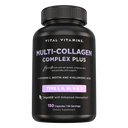
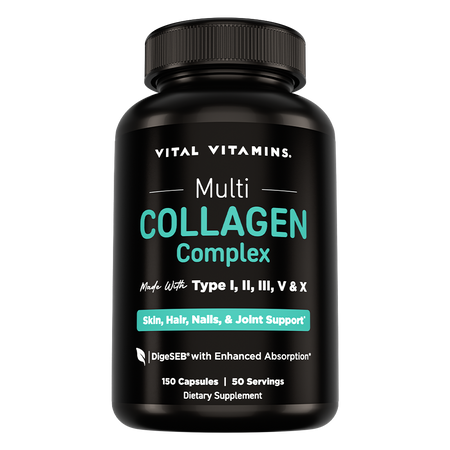
Because different collagen types support different tissues — skin, cartilage, tendons, bones — many people choose a multi-collagen approach rather than supplementing with just one type. A formula like Vital Vitamins Multi Collagen Complex provides types I, II, III, V, and X from multiple sources, giving your body comprehensive support in a single supplement.
The Benefits of Collagen Supplementation
Collagen provides your body with amino acids and small protein fragments — called peptides — that support tissue repair, structural integrity, and moisture retention. Here's what the evidence shows for the areas people ask about most.
Skin Health and Healthy Aging
As collagen synthesis slows with age, skin gradually loses hydration, elasticity, and firmness. The research here is encouraging. A systematic review of 26 randomized controlled trials involving 1,721 participants found that hydrolyzed collagen supplements significantly improved both skin hydration and elasticity. Marine collagen outperformed poultry-derived sources for hydration, and longer supplementation periods — at least eight weeks — produced larger, more consistent gains.2
Oral hydrolyzed collagen peptides are considered safe, cost-effective, and easy to incorporate into a daily routine. For most people, oral supplementation is the most practical starting point — and the research supports it as the most reliable method for delivering collagen's benefits from within.3
As always, if you have a medical condition or take medications, it's a good idea to speak with your healthcare provider before starting any new supplement.
Joint and Bone Support
Collagen supplementation has been shown to support bone strength and density, as well as joint mobility. Hydrolyzed collagen peptides and undenatured collagen are the two most-studied forms for joint health, and both show benefits — through different mechanisms.3
Hydrolyzed collagen can support tendon strength and thickness, while also helping limit bone collagen loss that can occur after intense training or injury. For those managing osteoporosis or age-related bone concerns, collagen may support calcium absorption and bone mineral density over time.
Muscle Recovery and Strength
Hydrolyzed collagen has been shown to help reduce muscle damage and soreness after physical activity.3 It provides key amino acids — especially glycine and proline — that play a role in tissue repair.
For even better results, pair your collagen supplement with a complete protein source like eggs, poultry, or your regular protein powder. This gives your body both the targeted connective-tissue support from collagen and the full amino acid profile — including leucine — needed for muscle protein synthesis. The two work well together.
For tendon-focused recovery or physical therapy, the research suggests taking 10–15 g of collagen with 50 mg of vitamin C about 30–45 minutes before loading or rehab exercises. This timing may help optimize collagen synthesis in the tendon itself.
How to Use Collagen in Your Routine
Collagen is versatile — it shows up in nutrition, skincare, and clinical practice, most often in peptide form. Here's how to make it work for you.
Oral Supplements
You can take hydrolyzed collagen — sometimes labeled as HC or collagen peptides — as a powder, capsule, or liquid. Certain collagen peptides have been shown to stimulate hyaluronic acid production in skin cells, which helps the skin retain moisture.
Clinical studies confirm that oral hydrolyzed collagen can significantly improve skin hydration and elasticity, with the clearest gains appearing after eight or more weeks of consistent use.2 Results can vary depending on the source and, importantly, how consistently you take it.
Consistency matters more than timing. Many people find it easy to stir a scoop into their morning coffee or take a capsule with breakfast. Long-term studies covering months to years have reported no serious adverse effects.
When choosing a collagen supplement, look for a formula that includes hydrolyzed collagen along with added vitamin C to support absorption and collagen synthesis. Vital Vitamins Multi Collagen Complex includes five collagen types from multiple sources — bovine, chicken, fish, and eggshell membrane — making it a simple way to cover your bases in a single daily serving.
Skincare Products
Collagen is a common ingredient in creams, serums, and other topical products designed to support skin density, elasticity, and hydration.7 Sources include marine, bovine, and porcine collagen.
Hydrolyzed collagen contains smaller peptide fragments, which allows for better absorption when applied topically. Its strong water-binding capacity also makes it an effective moisturizer and texture-improving ingredient.
When scanning labels, look for hydrolyzed collagen and humectants — ingredients that draw and hold moisture — for the best combination of penetration and hydration.
Medical and Clinical Applications
Beyond daily wellness, collagen is used in clinical settings to support skin regeneration, wound healing, and the management of osteoarthritis and rheumatoid arthritis.8 Tissue engineers also use type I collagen scaffolds for applications like nerve regeneration and bone repair, thanks to collagen's low immunogenicity and high biocompatibility.
Research continues to expand our understanding of collagen's clinical potential, and the growing body of evidence speaks to just how foundational this protein is for the body.
The Bottom Line
Collagen is one of the most abundant — and most important — proteins in your body, and its gradual decline with age affects everything from your skin to your joints to your bones. The good news is that the research consistently supports collagen supplementation as a safe, effective way to give your body the building blocks it needs.
Whether you're focused on skin health, joint comfort, or recovery, the keys are the same: choose a quality hydrolyzed collagen with multiple types, pair it with vitamin C, stay consistent, and give it at least eight weeks. Small, steady habits add up — and your body will thank you for the support.
Ready to get started? Explore the full Vital Vitamins collagen lineup and find the formula that fits your goals.
As always, follow recommended serving guidelines and speak with a healthcare professional if you have any questions about what's right for you.