


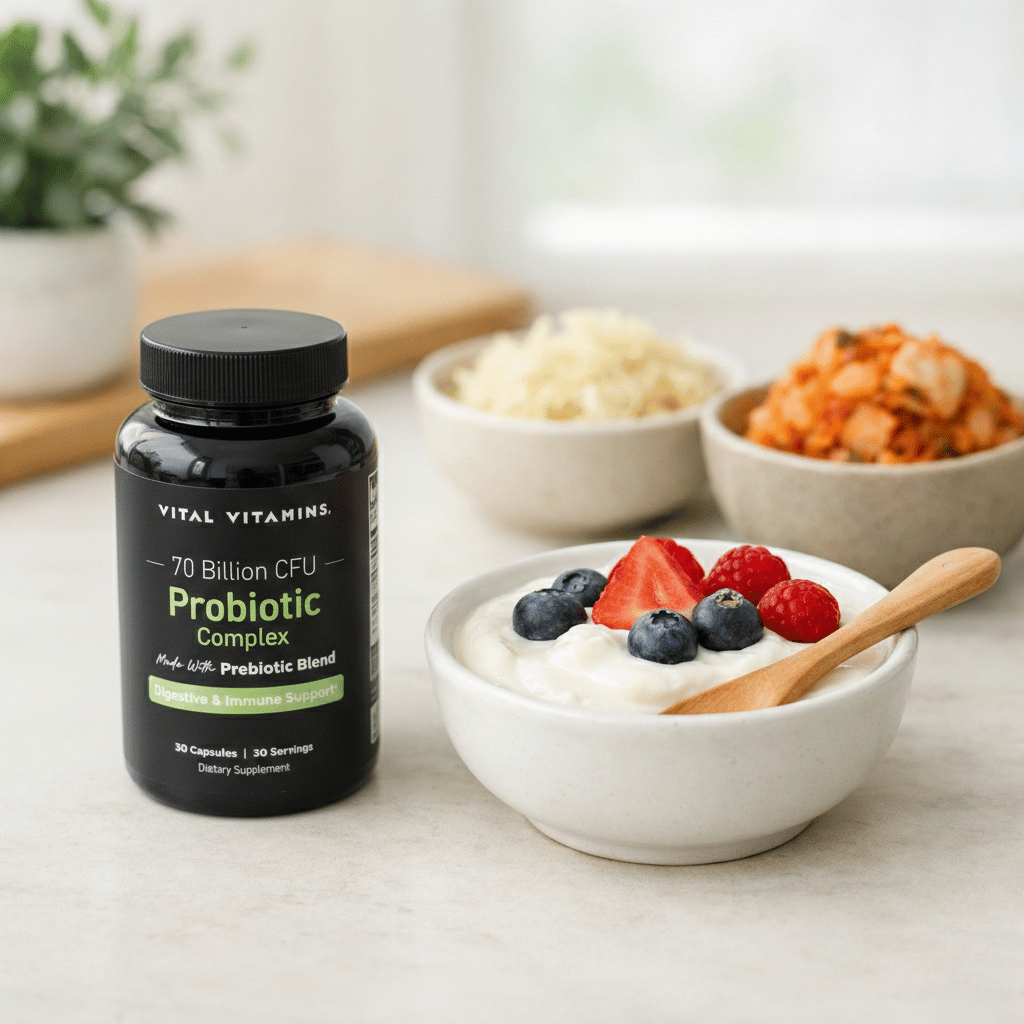
If your stomach doesn’t feel well, you don’t feel well. If you deal with bloating, irregularity, or a “heavy” stomach, your gut microbiome may need extra support. Probiotics are live microorganisms that help maintain a healthy balance of gut bacteria, which supports digestion and immune function.¹ This guide breaks down what probiotics are, how they work, and how to choose the right option for your goals—whether you prefer fermented foods, fortified foods, or a daily supplement.
Key Takeaways
-
Probiotics are live microorganisms that help support a balanced gut microbiome and digestive health¹
-
Benefits depend on the specific strain, dose, and consistency of use
-
Fermented foods, fortified foods, and supplements can all contribute to probiotic intake
-
Quality labeling and strain transparency matter when choosing products
-
Pairing probiotics with fiber-rich foods supports long-term gut and immune health
What Are Probiotics?
Probiotics are live microorganisms — primarily bacteria and certain yeasts — that provide health benefits when consumed in adequate amounts. This definition, established by the World Health Organization, is widely used in scientific research today.¹
Most probiotics belong to the Lactobacillus and Bifidobacterium genera, though other organisms such as Saccharomyces boulardii are also well studied. Each probiotic is identified by its genus, species, and strain — and that strain detail matters because different strains support the body in different ways.
Probiotics are different from prebiotics. Prebiotics are fermentable fibers that nourish beneficial gut bacteria. Together, probiotics and prebiotics help create an environment that supports digestive balance.
How Probiotics Work in the Gut
Your digestive tract is home to trillions of microorganisms that influence digestion, metabolism, and immune signaling. Probiotics support this ecosystem by helping maintain balance within the gut microbiome.
They do this by:
-
Competing with less helpful microbes for space and nutrients
-
Supporting the intestinal barrier
-
Helping produce short-chain fatty acids from dietary fiber
-
Interacting with immune cells in the gut
These actions support everyday digestive comfort and immune resilience. Importantly, probiotic effects are strain-specific, which is why product selection matters.²
What are the signs you need a probiotic?
Common signs a probiotic may be worth considering include occasional bloating, gas, or irregularity, recent antibiotic use, a diet low in fermented foods and fiber, and digestive changes when traveling. These signals suggest your gut's bacterial balance could use support. Probiotics may help maintain a healthy balance of gut microorganisms. Persistent or severe digestive symptoms are a reason to see a doctor, not a supplement cue.
- Occasional digestive discomfort: bloating, gas, or irregularity that comes and goes
- Recent antibiotics: a course of antibiotics affects beneficial bacteria along with harmful ones
- Low-fermented-food diet: few servings of yogurt, kefir, kimchi, or sauerkraut
- Routine disruption: travel, schedule changes, or diet changes that unsettle digestion
- See a doctor instead if: symptoms are persistent, severe, or come with weight loss or blood
None of these signs requires waiting for a perfect answer; probiotics are generally well tolerated by healthy adults. For everyday digestive support, our Probiotic Complex combines multiple probiotic strains in one daily capsule to help maintain a balanced gut.
Types of Probiotics
Lactobacillus
Lactobacillus species are among the most commonly used probiotics. They produce lactic acid, which helps support a balanced digestive environment.³
Well-studied strains such as Lactobacillus acidophilus, L. rhamnosus, and L. casei are commonly used to support digestion, regularity, and immune health. These bacteria naturally occur in the digestive tract and are widely used in fermented foods and supplements.
Bifidobacterium
Bifidobacterium species are important residents of a healthy adult gut. Strains such as B. longum, B. breve, and B. bifidum help support digestive balance and immune function.
Research suggests these strains can help support regularity, reduce occasional bloating, and promote overall gut comfort.⁴
Saccharomyces boulardii
Saccharomyces boulardii is a beneficial yeast that has been studied for digestive support, particularly during times of dietary change or antibiotic use.
It supports gut balance by interacting with the intestinal environment and supporting the gut lining. Because it is a yeast, it can be used alongside antibiotics when appropriate.⁵
Benefits of Probiotics for Gut Health
Supporting Microbiome Balance
Diet changes, stress, medications, and aging can all influence the gut microbiome. Probiotics help replenish beneficial organisms that support digestive balance and normal gut function.
Research shows that targeted probiotic use can help support microbiome stability during times of change, including after antibiotic use.²
Supporting Digestion and Regularity
Certain probiotic strains help support food breakdown, nutrient absorption, and regular bowel movements. Many people notice improved comfort, reduced bloating, and more consistent digestion with regular probiotic use.⁶
Both foods and supplements can contribute to these benefits, especially when paired with fiber-rich meals.
Supporting Immune Health
A significant portion of the immune system resides in the gut. Probiotics interact with immune cells and help support balanced immune responses.
Some strains have been studied for their role in supporting immune resilience during everyday stressors and seasonal challenges.⁴
Sources of Probiotics
Fermented Foods
Fermented foods naturally contain beneficial bacteria created during traditional preparation methods. Common options include yogurt with live cultures, kefir, sauerkraut, kimchi, miso, and kombucha.
Labels that state “live and active cultures” help confirm the presence of probiotics. These foods can be a valuable part of a gut-supportive diet.⁸
Probiotic Supplements
Supplements provide a convenient and consistent way to consume specific probiotic strains at known doses. Many people choose supplements when they want targeted support or prefer a capsule-based routine.
High-quality supplements clearly list:
-
Genus, species, and strain
-
CFU count guaranteed through expiration
-
Proper storage guidance
Our Vital Vitamins Probiotic Complex is a well-rounded option formulated with multiple researched strains designed to support digestive balance and immune health as part of a daily wellness routine.
Fortified Foods
Some foods and beverages have probiotics added during production. These products can offer convenient ways to increase probiotic intake and fit easily into everyday routines.
As with any functional food, reading labels helps ensure the product aligns with your personal nutrition goals.
What is a probiotic supplement good for?
A probiotic supplement is good for supporting a balanced gut microbiome, the community of trillions of microorganisms living in your digestive tract. Specific strains may help support comfortable digestion, regularity, immune function, and the maintenance of healthy intestinal flora when routines change. Benefits are strain-specific rather than universal, and they build with consistent daily use, typically over several weeks.
| Area of support | What research suggests |
|---|---|
| Digestive comfort | Certain strains may help support comfortable digestion and regularity |
| Microbiome balance | May help maintain healthy intestinal flora, especially when diet or routine shifts |
| Immune function | A large share of immune tissue sits in the gut; specific strains may support immune health |
| Strain specificity | Effects documented for one strain don't automatically apply to another |
Because effects are strain-specific, a formula that covers several well-studied strains is a practical starting point for general gut support. Our multi-strain Probiotic Complex supplement is designed for daily use to support digestive balance over time.
Prebiotics, Synbiotics, and Postbiotics
Prebiotics are fermentable fibers found in foods like onions, bananas, garlic, oats, and chicory root. They nourish beneficial gut bacteria and support the production of short-chain fatty acids.
Synbiotics combine probiotics with prebiotics in one product to support bacterial survival and activity.
Postbiotics are beneficial compounds produced when gut bacteria ferment fibers. These compounds may support gut and immune health without introducing live organisms.
Choosing the Right Probiotic
Choosing a probiotic starts with identifying your goal. Some strains are studied more for digestive comfort, others for immune support or use during antibiotic courses.¹⁰
When evaluating products, look for:
-
Clear strain identification
-
Appropriate CFU levels
-
Transparent labeling and quality standards
More is not always better — evidence-based formulation and consistency matter most.
Safety and Tolerance
Most healthy adults tolerate probiotics well. Mild digestive changes, such as gas or bloating, may occur when starting a new product and usually resolve within a few days.
Individuals with specific medical conditions or weakened immune systems should consult a healthcare provider before beginning probiotic supplementation.¹²
How to Use Probiotics Effectively
Consistency is key. Many people take probiotics daily, often with meals, to support routine use.
For best results:
-
Use probiotics regularly
-
Include fiber-rich foods in your diet
-
Maintain overall balanced nutrition and hydration
When combined with healthy habits, probiotics can support digestive comfort over time.¹³
Conclusion
Probiotics play a valuable role in supporting gut health, digestion, and immune balance. By helping maintain a diverse and balanced microbiome, they support everyday wellness and long-term digestive comfort.
Benefits depend on the strains used, product quality, and consistency. Whether through foods, supplements, or a combination of both, probiotics can be a simple, effective addition to a balanced wellness routine.
Small, steady choices today can support how you feel tomorrow.
FAQs
1) What are probiotics, and what do they do?
Probiotics are live microorganisms (usually bacteria or yeast) that provide health benefits when taken in adequate amounts. They help support a balanced gut microbiome, which plays a role in digestion, regularity, and immune support.¹
2) How long does it take to notice results from probiotics?
Many people notice changes in digestion within a few days to a few weeks, but results vary based on the strain, dose, and your starting gut balance. Consistent daily use tends to work best.²
3) Should I take probiotics every day?
Daily use is common and often recommended for steady support, especially if you’re using probiotics for digestive comfort or routine microbiome maintenance. If you prefer, you can also use them in targeted periods (like during travel or diet changes), depending on your needs.¹²
4) Are higher CFUs always better?
Not necessarily. CFUs (colony-forming units) measure how many live organisms you’re taking, but the strain and product quality matter more than choosing the highest number. A well-formulated probiotic with researched strains and clear labeling is usually the smarter pick.¹
Endnotes
-
Hill C., et al. Expert consensus on the definition and scope of probiotics. Nature Reviews Gastroenterology & Hepatology. 2014. https://ods.od.nih.gov/factsheets/Probiotics-HealthProfessional/
-
Sanders M.E., et al. Mechanisms of action for probiotic effects. Gut Microbes. 2018. https://pmc.ncbi.nlm.nih.gov/articles/PMC10470842/
-
Zheng J., et al. Taxonomic structure of the genus Lactobacillus. International Journal of Systematic and Evolutionary Microbiology. 2020. https://pmc.ncbi.nlm.nih.gov/articles/PMC9019120/
-
O’Callaghan A., van Sinderen D. Bifidobacteria and immune support. Frontiers in Microbiology. 2016. https://pmc.ncbi.nlm.nih.gov/articles/PMC8727868/
-
McFarland L.V. Systematic review of Saccharomyces boulardii. World Journal of Gastroenterology. 2010. https://pmc.ncbi.nlm.nih.gov/articles/PMC3296087/
-
Ford A.C., et al. Probiotics for digestive comfort. The American Journal of Gastroenterology. 2018. https://www.sciencedirect.com/science/article/pii/S2772502225004986
-
Boyle R.J., et al. Probiotics and safety considerations. Clinical & Experimental Allergy. 2006. https://pmc.ncbi.nlm.nih.gov/articles/PMC3539293/
-
Marco M.L., et al. Fermented foods and gut health. Nature Reviews Gastroenterology & Hepatology. 2021. https://pmc.ncbi.nlm.nih.gov/articles/PMC8588917/
-
Rezac S., et al. Probiotic content of fermented foods. Current Opinion in Food Science. 2018. https://www.sciencedirect.com/science/article/pii/S2161831325000481
-
Szajewska H., et al. Probiotic strains supported by RCTs. PLOS ONE. 2019. https://journals.plos.org/plosone/article?id=10.1371/journal.pone.0209205
-
McFarland L.V., et al. Label accuracy in probiotic supplements. Therapeutic Advances in Gastroenterology. 2018. https://pmc.ncbi.nlm.nih.gov/articles/PMC6306248/
-
Doron S., et al. Risk assessment for probiotic use. Heliyon. 2024. https://www.sciencedirect.com/science/article/pii/S2405844024039392
-
Cleveland Clinic. Best timing for probiotics. 2025. https://health.clevelandclinic.org/best-time-to-take-probiotics
- NIH Office of Dietary Supplements. Probiotics: Fact Sheet for Health Professionals.
- Hill C, et al. The ISAPP consensus statement on the scope and appropriate use of the term probiotic. Nat Rev Gastroenterol Hepatol, 2014.