

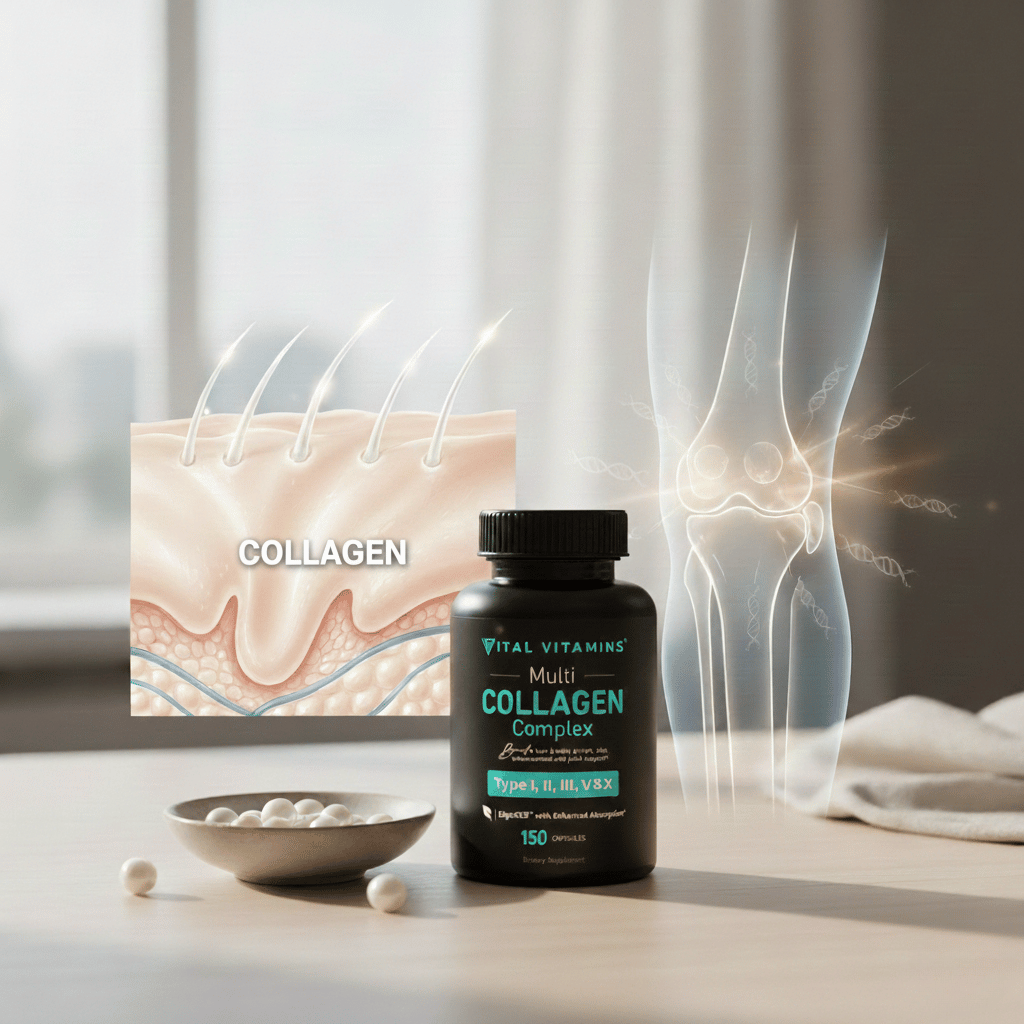
Collagen plays a major role with skin and joint health. It is the most abundant protein in the body and accounts for about 30% of total body protein. (1)
This guide walks through seven research-backed ways collagen—especially hydrolyzed collagen peptides—can support skin and joint health. You’ll also learn what collagen is, why levels change over time, where to find it in food, and how vitamin C supports your body’s natural collagen production.
Each of these benefits is covered in more depth in our complete guide to collagen supplements.Key Takeaways
-
Collagen accounts for about 30% of your body’s total protein and supports the structure of skin, bones, and connective tissues. (1)
-
A 2025 systematic review and meta-analysis found oral collagen supplements significantly improved skin hydration and elasticity, with commonly used doses ranging from 1–10 grams per day (median ~3.5 g/day). (2)
-
Research reviews in knee osteoarthritis suggest collagen peptides can reduce pain compared to placebo, with no significant difference in adverse events in analyzed trials. (3)
-
Natural collagen production declines with age, with a more pronounced drop after menopause. (1)
- Sun exposure, smoking, and other lifestyle factors can accelerate collagen breakdown. (1,4,5)
What Is Collagen?
Collagen is a strong, fiber-like protein that gives structure to skin, tendons, ligaments, bones, and cartilage. Your body builds collagen from amino acids—primarily glycine, proline, and hydroxyproline—arranged in a triple-helix structure. (1)
Researchers have identified around 28 types of collagen. The most commonly discussed include:
-
Type I: the most abundant; supports skin, bones, tendons, and ligaments
-
Type II: supports cartilage and joint cushioning
-
Type III: supports muscles, arteries, and organs
-
Type IV: found in layers of skin
-
Type V: found in the cornea, hair, and some skin layers
Your body also relies on key nutrients to build stable collagen, including vitamin C, zinc, copper, and manganese. (1)
How Collagen Works in the Body
Collagen acts as an internal support framework. In skin, it helps maintain firmness and elasticity. In joints, it supports cartilage structure and resilience.
When you consume collagen from food or supplements, digestion breaks it down into amino acids and peptides. Your body then uses those building blocks where they’re needed—skin, cartilage, muscle, and connective tissue. Collagen does not directly “go to the skin,” but it supports the materials your body uses to maintain healthy tissues over time. (4)
Many supplements use hydrolyzed collagen peptides, which are pre-broken down for easier mixing and digestion.
7 Science-Backed Collagen Benefits for Skin and Joints
1. Supports skin hydration
A 2025 systematic review and meta-analysis of randomized controlled trials found that oral collagen supplementation significantly improved skin hydration compared to control groups. (2)
Hydrated skin often feels smoother and more comfortable, especially as natural moisture levels shift with age.
2. Supports skin elasticity
The same meta-analysis also found significant improvements in skin elasticity—a key factor in how resilient and supple skin looks and feels. (2)
3. Helps soften the look of fine lines over time
Collagen supports the structure beneath the skin’s surface. When hydration and elasticity improve, fine lines often appear less noticeable. Research reviews consistently associate oral collagen use with improvements in visible signs of skin aging when used consistently for several weeks. (2,4)
4. Supports skin firmness and texture
Collagen contributes to the strength and structure of the dermis, the middle layer of skin. As collagen production slows with age, skin can lose firmness. Supporting collagen turnover through diet and supplementation may help maintain smoother texture and firmness over time. (1,4)
5. Supports joint comfort in wear-and-tear knees
Collagen peptides have been studied for joint comfort, particularly in people with knee osteoarthritis. A 2023 meta-analysis of randomized controlled trials found collagen peptides significantly reduced pain compared with placebo. (3)
This does not mean collagen treats arthritis, but it may support joint comfort in that population.
6. Supports cartilage structure and joint resilience
Cartilage contains a high concentration of collagen, especially type II. Providing collagen peptides and adequate protein supplies raw materials your body uses to maintain connective tissues. Some studies suggest collagen peptides may influence markers related to cartilage structure and joint function. (1,3)
7. Supports mobility and daily movement
When joints feel better supported, everyday movement often feels easier. Studies evaluating collagen peptides for joint comfort commonly measure outcomes such as stiffness and physical function, which directly relate to mobility. (3)
Why Collagen Declines Over Time
Collagen production naturally decreases with age, and existing collagen breaks down more quickly. Women may experience a sharper decline after menopause, and most people see noticeable reductions by their 60s. (1)
Lifestyle and environmental factors can accelerate collagen breakdown. Excess sun exposure and smoking are both associated with faster collagen degradation. (1,4) Ultraviolet radiation increases enzymes called matrix metalloproteinases, which break down collagen in the skin. (5)
Where to Get Collagen
Collagen-rich foods
Collagen naturally occurs in animal connective tissues. Common sources include:
-
Bone broth (collagen content varies widely)
-
Meat or fish with connective tissue
-
Gelatin, a cooked form of collagen
Collagen itself is found in animal flesh, while many plant foods support collagen production indirectly by supplying amino acids and key nutrients. (4)
Collagen supplements
Collagen supplements are typically derived from bovine, marine, chicken, or eggshell membrane sources and are available as powders or capsules. Many use hydrolyzed collagen peptides, which dissolve easily and are generally well tolerated.
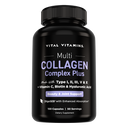
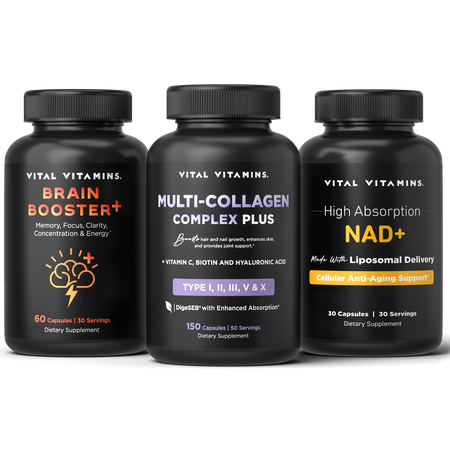
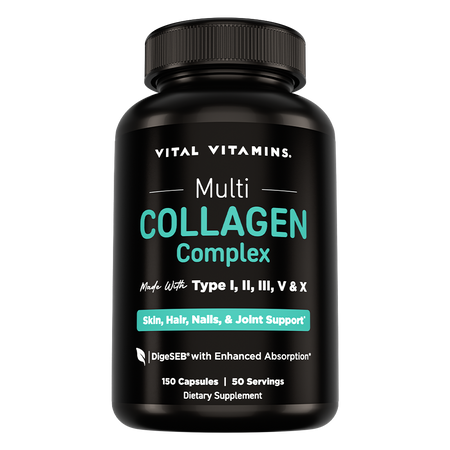
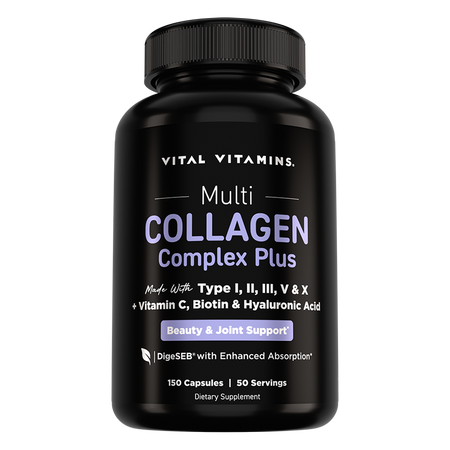
When choosing a supplement, look for clear sourcing, minimal added ingredients, and a blend that includes multiple collagen types to support both skin and joint health. For example, Vital Vitamins’ Multi-Collagen Complex Peptides Powder combines several collagen types in a hydrolyzed form designed to mix easily into coffee, smoothies, or other daily staples. This kind of multi-source formula can be a convenient option for people seeking broader connective tissue support in one daily serving.
As with any supplement, collagen works best alongside a balanced diet and vitamin C–rich foods that support natural collagen production.
How to Support Collagen Production More Effectively
-
Pair collagen with vitamin C–rich foods such as citrus fruits, berries, and bell peppers. Vitamin C supports key enzyme steps in collagen formation. (6)
-
Use sunscreen consistently, as UV exposure accelerates collagen breakdown in skin. (5)
-
Avoid smoking, which damages collagen and accelerates visible aging changes. (1,4)
- Stay consistent. Many skin-focused studies evaluated collagen use over several weeks, with effective doses commonly within the 1–10 g/day range. (2)
Final Thoughts
Collagen supports the structure of skin and joints, and research suggests collagen peptides can improve skin hydration and elasticity and may support joint comfort when used consistently as part of a healthy routine. (2,3)
A simple daily habit—such as mixing collagen peptides into coffee, smoothies, or oatmeal—can fit easily into most routines, especially when paired with vitamin C–rich foods and skin-protective habits like sunscreen.
Endnotes
-
Cleveland Clinic. Collagen accounts for ~30% of total body protein; production declines with age and after menopause. Cleveland Clinic. 2024. https://my.clevelandclinic.org/health/articles/23089-collagen
-
Danessa G., et al. Oral collagen supplements improved skin hydration and elasticity in RCTs; common dosing ranged 1–10 g/day. Indian J Dermatol Venereol Leprol. 2025. https://ijdvl.com/effects-of-collagen-based-supplements-on-skins-hydration-and-elasticity-a-systematic-review-and-meta-analysis/
-
Lin X., et al. Collagen peptides reduced pain vs placebo in knee osteoarthritis trials, with no significant difference in adverse events. J Orthop Surg Res. 2023. https://link.springer.com/content/pdf/10.1186/s13018-023-04182-w.pdf
-
Harvard T.H. Chan School of Public Health. Collagen supports connective tissue; aging and lifestyle factors can reduce collagen integrity over time. The Nutrition Source. 2024. https://nutritionsource.hsph.harvard.edu/collagen/
-
Rinnerthaler M., et al. UV radiation accelerates collagen damage through increased matrix metalloproteinase activity and collagen fragmentation. Int J Mol Sci. 2022. https://pmc.ncbi.nlm.nih.gov/articles/PMC9307547/
-
Lumen Learning. Vitamin C acts as a cofactor for enzymes involved in collagen formation (prolyl and lysyl hydroxylase). Nutrition Flexbook. 2024. https://courses.lumenlearning.com/suny-nutrition/chapter/9-32-enzymatic-functions/