

Mental clarity, focus, and memory are essential at every stage of life. Whether you’re navigating busy workdays, managing stress, or supporting healthy aging, the nutrients you provide your brain can play an important role in how you feel day to day.
Research shows that specific vitamins, fatty acids, plant extracts, and amino acids support key brain processes — including neurotransmitter signaling, circulation, energy production, and protection against everyday oxidative stress.¹ Rather than acting as quick fixes, these ingredients work best as part of a consistent, long-term wellness routine.
This guide highlights 11 research-supported ingredients to look for in brain health supplements, explaining what they do and how they support cognitive wellness — so you can make informed, confident choices.
Key Takeaways
-
Omega-3 fatty acids, especially DHA and EPA, support brain structure, circulation, and cognitive performance at daily intakes up to 3 grams.¹
-
Phosphatidylserine supports healthy neurotransmitter signaling and cell membrane function related to memory and focus.²
-
Botanical extracts such as Ginkgo biloba, Bacopa monnieri, and Lion’s Mane mushroom provide antioxidant and neuro-supportive benefits.⁴⁻⁸
-
B vitamins (B6, folate, and B12) help regulate homocysteine and support energy metabolism in brain cells.⁹
-
Antioxidant-rich extracts like grape seed, bilberry, and blueberry help protect brain tissue from oxidative stress over time.¹³
1. Omega-3 Fatty Acids (DHA & EPA)
Omega-3 fatty acids form a structural foundation for brain health. DHA is the most abundant omega-3 in the brain, where it supports flexible cell membranes and efficient communication between neurons. EPA complements DHA by supporting healthy blood flow and signaling pathways involved in cognition.¹
A systematic review of nine randomized controlled trials involving more than 1,300 participants found omega-3 supplementation supported cognitive well-being and cerebral circulation.¹ Intakes up to 3 grams per day are widely considered appropriate for most adults.
Because of their broad role in brain structure and function, omega-3s are often viewed as a cornerstone nutrient in cognitive wellness formulas.
2. Phosphatidylserine (PS)
Phosphatidylserine is a naturally occurring phospholipid found in high concentrations within brain cell membranes.² It plays an important role in maintaining membrane integrity and supporting communication between brain cells.
Research suggests phosphatidylserine supports memory, learning, and focus, particularly as part of an overall approach to healthy cognitive aging.² Its role in neurotransmitter signaling makes it a common inclusion in comprehensive brain-support supplements.
3. Ginkgo Biloba
Ginkgo biloba is one of the most extensively studied botanical ingredients for cognitive health. Standardized extracts such as EGb 761 contain flavonoids and terpene lactones that provide antioxidant support and help maintain healthy cerebral circulation.⁴⁻⁵
Clinical studies commonly use doses between 120–240 mg per day, with research linking Ginkgo to support for memory, attention, and mental clarity. Its long history of use and well-documented safety profile make it a popular choice in brain health formulas.
4. Bacopa Monnieri
Bacopa monnieri has been used in traditional Ayurvedic practices for centuries to support memory and mental balance. Modern research shows Bacopa provides antioxidant support and helps maintain normal neurotransmitter activity involved in learning and recall.⁶
Rather than acting as a stimulant, Bacopa supports cognitive function gradually, making it well suited for long-term brain wellness routines.
5. Lion’s Mane Mushroom
Lion’s Mane mushroom contains unique bioactive compounds — hericenones and erinacines — that support nerve growth factor (NGF), a protein involved in neuron maintenance and adaptability.⁷
Early human studies suggest Lion’s Mane may support memory, focus, and mood when used consistently.⁸ Its role in supporting neural health has made it a growing favorite in modern cognitive formulas.
6. Choline & Choline Precursors (Alpha-GPC)
Choline is an essential nutrient used to produce acetylcholine, a neurotransmitter involved in memory, attention, and learning. Alpha-GPC is a highly bioavailable choline source that efficiently supports acetylcholine production.
Choline also contributes to healthy cell membrane structure, supporting cognitive function as part of a balanced nutrition plan.
7. B Vitamins (B6, Folate, B12)
B vitamins play a key role in brain energy metabolism and neurotransmitter synthesis. Folate and vitamin B12 help regulate homocysteine levels, supporting vascular and cognitive health.⁹
While individual study results vary, maintaining adequate intake of these vitamins is widely recognized as important for long-term cognitive wellness, especially as nutritional needs change with age.¹⁰
8. Rhodiola Rosea
Rhodiola rosea is an adaptogenic herb traditionally used to support resilience to physical and mental stress. Research on standardized extracts suggests it may support mood, mental stamina, and perceived energy levels.¹¹
By supporting the body’s stress-response systems, Rhodiola can complement cognitive wellness efforts during demanding periods.
9. Antioxidant Botanical Extracts
(Grape Seed, Bilberry & Blueberry)
These botanical extracts supply concentrated polyphenols and anthocyanins that help neutralize free radicals. Antioxidant support is important for protecting brain cells from oxidative stress that naturally accumulates over time.¹³
Research links grape seed extract with vascular support, while bilberry and blueberry compounds are associated with memory and cognitive performance in aging populations.
10. Amino Acids & Targeted Nootropics
(Acetyl-L-Carnitine, NAC, Alpha-Lipoic Acid)
Certain amino acids and related compounds support brain energy production and antioxidant defenses:
-
Acetyl-L-carnitine (ALCAR) supports mitochondrial energy metabolism
-
N-acetyl-L-cysteine (NAC) supports glutathione production and oxidative balance
-
Alpha-lipoic acid functions as a versatile antioxidant in both fat- and water-based tissues
These ingredients are commonly combined to support mental clarity and long-term cognitive resilience.
11. Huperzine A
Huperzine A is a plant-derived compound that supports acetylcholine availability by slowing its natural breakdown.¹⁴ This mechanism makes it a popular ingredient for short-term memory and focus support.
Supplemental amounts are typically measured in micrograms and are designed to complement broader brain-support formulations.
Bringing It All Together
High-quality brain health supplements focus on supporting multiple pathways at once — including brain structure, neurotransmitter signaling, circulation, and cellular protection. Ingredients such as omega-3 fatty acids, phosphatidylserine, B vitamins, botanical extracts, and targeted nootropics work together to support mental clarity and cognitive wellness over time.
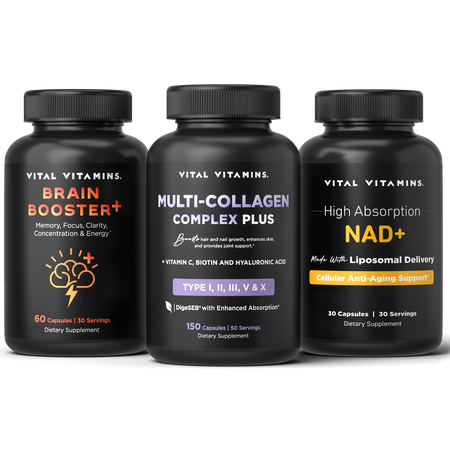
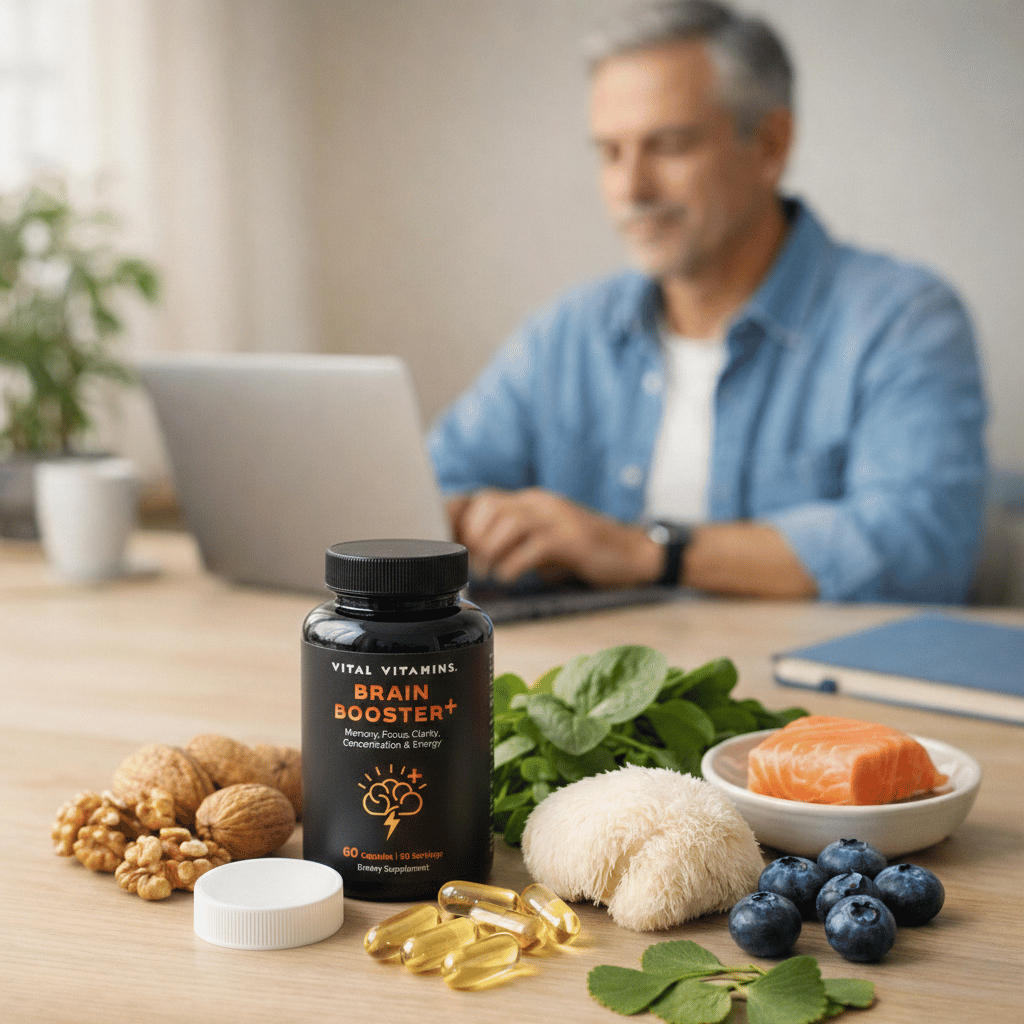
Well-rounded formulas like Brain Booster Plus combine evidence-backed ingredients into a convenient daily option designed to support focus, memory, and long-term brain health — without relying on stimulants.
As always, consistency matters. Review labels carefully, follow recommended serving sizes, and consult a qualified healthcare professional if you take medications or have specific health considerations. With the right nutrients and a steady routine, supporting your brain can feel both practical and empowering.
Endnotes
-
Yurko-Mauro K., et al. Omega-3 fatty acids support cognitive function and cerebral blood flow. Nutrients. 2022. https://pmc.ncbi.nlm.nih.gov/articles/PMC9641984/
-
Glade M.J., et al. Phosphatidylserine and brain cell membrane signaling. Nutrients. 2022. https://pmc.ncbi.nlm.nih.gov/articles/PMC9382310/
-
Li Z., et al. Phosphatidylserine metabolism and synaptic pruning. Trends in Neurosciences. 2023. https://www.sciencedirect.com/science/article/pii/S2590259823000328
-
Smith J.V., et al. Ginkgo biloba extract EGb 761 and memory support. Neural Regeneration Research. 2021. https://pmc.ncbi.nlm.nih.gov/articles/PMC8014356/
-
Mahadevan S., et al. Ginkgo biloba safety and pharmacology. StatPearls. 2024. https://www.ncbi.nlm.nih.gov/books/NBK541024/
-
Stough C., et al. Bacopa monnieri and cognitive performance. Biomedicine & Pharmacotherapy. 2022. https://www.sciencedirect.com/science/article/pii/S0753332222008587
-
ONS Staff. Evidence overview of Lion’s Mane mushroom. Oncology Nursing Society. 2024. https://www.ons.org/publications-research/voice/news-views/11-2024/what-evidence-says-about-lions-mane-mushroom
-
Nagano M., et al. Lion’s Mane mushroom and cognitive function. Nutrients. 2023. https://pmc.ncbi.nlm.nih.gov/articles/PMC10675414/
-
Smith A.D., et al. Homocysteine, B vitamins, and cognitive aging. Advances in Nutrition. 2022. https://www.sciencedirect.com/science/article/pii/S2161831322010742
-
Moore E., et al. B vitamin status and cognitive health in aging. Nutrients. 2016. https://pmc.ncbi.nlm.nih.gov/articles/PMC4772032/
-
Amsterdam J.D., et al. Rhodiola rosea and stress resilience. Phytomedicine. 2018. https://pmc.ncbi.nlm.nih.gov/articles/PMC6208354/
-
Panossian A., et al. Adaptogenic properties of Rhodiola rosea. Frontiers in Pharmacology. 2022. https://pmc.ncbi.nlm.nih.gov/articles/PMC9228580/
-
Barfoot K.L., et al. Polyphenols and cognitive protection. Nutrients. 2021. https://www.mdpi.com/2072-6643/13/5/1692
-
Goldstein E.R., et al. Huperzine A and cognitive performance. Journal of the International Society of Sports Nutrition. 2021. https://pmc.ncbi.nlm.nih.gov/articles/PMC8439683/
-
Yang G., et al. Huperzine A pharmacology and applications. Frontiers in Pharmacology. 2020. https://pubmed.ncbi.nlm.nih.gov/31990212/